👋 Blog Post to Say Goodbye

Hey all, Chris here. It’s been a while since I’ve posted on the Blog, the last time was actually when we launched the LongMill MK2.5 which was posted nearly 2 years ago on May 10, 2024, so I hope my writing doesn’t come across as too rusty.

I’m glad to be writing to you all again, though in this case this will be the last time, as I wanted to let you know that I’ll be leaving Sienci Labs both as CTO and co-owner to begin a new chapter of my life. In light of this, I felt there was no way that I would be able to leave without at least attempting a final walk down memory lane so I could share with you some of the impacting experiences and community moments that stood out to me. So, if you’ll indulge me, I’ll do my best to capture these even though we all know there’s no way I’ll be able to summarize 10 years of all the time, energy, and passion I’ve put into building Sienci Labs from the ground-up, as well as all the time I’ve shared with so many of you through support emails, Facebook comments, Forum threads, calls, in-person meetups, Livestreams and more.

Before starting down memory lane though, here are some other housekeeping items that I should elaborate on first:

  • Why am I leaving? As everyone knows life is complex and always shifting and sometimes you just have to embrace it. After much consideration I felt it would make sense for me to move on to other things at this stage in my life.
  • Why also leave as an owner? This was the choice that I felt made the most sense. Andy and I both have built this company from the ground-up with no outside investment because we felt that those who own the company should be the ones involved in the day-to-day of building it. Since I was looking to move on, it felt like the right thing to also work with Andy to return all my ownership back to the company.
  • How will this change things at Sienci? In my view you shouldn’t really see any change. This probably sounds weird for me to say since you’d imagine that one of the key co-founders leaving would make a larger impact, but from my perspective there are a couple key aspects that I feel makes this statement true. Firstly, from day one Andy and I have worked hard to establish and make known the key priorities of Sienci Labs, including community openness, open source, and accessibility, and I believe that by instilling these pillars in our team it ensures that these goals can continue on through each of them. Secondly, as my role at the company has evolved over the years, we’ve already brought on people to fill the gaps to much success between my input or mentorship and their own talents including engineering, packaging design, QA, documentation, marketing, video creation, etc. This past experience allows present-day transitions to happen quite smoothly when there’s good planning and communication. Lastly, to give more context to the second point, recently my efforts at the company have been in projects that have either now released or are shortly releasing including heading the gSender 1.5.0 ‘New U’ redesign, the original board design and firmware behind the SLB and all the related documentation, filling the gaps on the new gSender 1.6.0 release, handling transition back to the core grblHAL firmware, and then onboarding new talent to finish that work and handle future SLB work. This means I’m in a good spot to hand the reins of successful, long-term projects over to either Andy or other talented individuals we’ve brought on, and I have great confidence that they can continue from there.
  • Should I still keep messaging you about Sienci stuff? Unfortunately no, I won’t be the right person to talk to anymore, but there are a lot of great and knowledgeable people you can always reach through Sienci customer support. We’ll also do our best to distribute this Blog post across our various channels so that people who might’ve gotten a reply from me recently on places like our Forum or Github should know to expect any future follow-ups to come from someone else on our team due to my departure.
  • What are you moving on to? For now I’ll be taking a very long overdue break as well as looking after some family and friends, then we’ll see from there.

I hope that answers most of the important questions. From my view Sienci Labs is in good hands. The team is strong, the vision is clear, and though I’m sad to say goodbye I wish the absolute best for the company to continue building tools that empower creativity and innovation.

For anyone happy to finish reading here (as I know that the following reminiscing might only be interesting for certain groups of people), my final words would be: have a great week, be well, help others, enjoy CNCing, and remember that feedback will always encourage Sienci and other companies in the space to keep improving! (:

How This All Started

I’m sure that between videos and blog posts, anyone who’s followed our company from the start may already have a decent idea of the path we took to where we’re at now, so I’ll try to offer up some less-mentioned insights from my own experiences.

From my view, the birth of Sienci and its core tenants started from Andy and my immersion and thankfulness to the multitude of prior community-founded efforts towards the democratization and increase in accessibility of at-home manufacturing, and honestly just the broader ‘maker’ movement as a whole. This movement had achieved a much larger mass adoption since the late 90’s and early 2000’s and had made a large impact on both of our lives and our passion for making as we grew up. Little did we know that due to a combination of our experiences, some of Andy’s unique ideas, some handy grant programs, and lots of gumption and elbow grease, we’d find ourselves starting a company in a literal garage and use this opportunity to finally give back to this community we’d felt so grateful to be a part of.

Shout out to all those who still own an original Mill One!

All these years later, I still try to channel the original ambition we both held back in the day. We thought that within 5 years we’d be able to make a CNC that was so smart and easy to use that you’d only need to click a single button and it would make you your final part, the truest essence of ‘lights out manufacturing’. Of course this would prove much more difficult than we expected, but I’m still so glad that we had a bit of ignorance, essentially, in these early days because every technological effort needs to start somewhere. We also came to better understand that we needed to take more focused steps on our path to that final goal, and this wound up helping us to better understand the other essential parts of a business that make a product work and helps users to feel supported, like:

  • Committed customer support
  • Support documents and videos (fun fact, our original Mill One assembly video series was voiced by my father)
  • Teaching software usage
  • Providing user inspiration for projects
  • And all the other parts of an ecosystem that transforms the experience from a transactional purchase to a fully supported journey.

It was a relief then when we finally found our financial footing through the feedback of our early community, who led us toward designing and launching the LongMill on Kickstarter. We’d been quite anxious because after several years it was still a real possibility that we’d have had to throw in the towel due to running very low on cash, and luckily the campaign helped us get back on track.

We were so grateful to see the whirlwind of responses and enthusiasm. I remember being so excited that I was more than happy to spend a late night putting together a video to answer a really common question we’d be getting of “can I use the LongMill vertically?”: https://youtu.be/Kpeo68LFmM0 (fun fact, this became one of our most watched videos over the next couple years, and a couple months later we also had fun standing on the machine while it was running)

How Sienci Has Grown

Skipping from those first 3 formative years to present day, 10 years after we began this whole journey, I can’t help but feel like a proud father who’s watched their child grow up, and look back in fondness despite the arduous journey. Back in the day, the first full-time people that joined our team were pivotal since money was tight and there was lots to do with little margin for error, but it became such a nice flow once we got past 5, then 10, then 20. The extra hands meant we were able to invest so much more time into the things we cared about like higher quality control, more reliable machine availability, and more resources of higher quality to assemble and learn how to use our CNCs. We also we able to allot more budget into much more complex R&D efforts like custom extrusion designs, gSender (to this day, one of my proudest projects I’ve ever undertaken), better electronics, enhanced firmware features, and eventually even larger machines and more complex add-ons like lasers, rotary axes, novel touch plates, and even custom cutting tools. We’re also now a team of almost 60.

It’s also been amazing to see our great community of CNCers grow alongside us. It’s not typical to have such a helpful group of people all together in one place, and I’m proud to have been joined by many of you in fostering that over the years on both our Facebook group and our Forum. I think it’s great that we can act to not only help those with our machines, but also welcome those from other areas of the CNC community since I’ve always felt that a rising tide lifts all boats. I dug up an old screenshot that I took when I was so excited our Facebook group was about to hit one thousand members, and it’s amazing to see us now past 15k, plus several thousand more on the Forum, and many Github contributors who we’re so happy and grateful to be working alongside. Our community also easily covers the globe now, spanning all continents (except Antarctica) and even some countries I’d never imagined we’d be in including remote islands in the middle of the Pacific ocean!

#image_title

I also want to give a personal shoutout and thanks to some group contributors (and our amazing Forum moderator) who I’ve greatly appreciated chatting alongside through many years in: Grant W, Don R, Jim H, Francis M, Matt M, Bill I, Michael P, Ian G, Heyward O, Bill K, Jeff W, Edwin S, James D, Greg D, Greg C, Jeremy F, Tomek, Tex, John O, Neil F, Ed B, Jens, and Chucky (sorry if I missed anyone else). Anyone who’s been around for a while will probably recognize these individuals for their many contributions toward either answering questions, contributing ideas or code, fending off spam bots, and even bringing some of their own designs to the community; thank you all for all your help along the way, I can say it was a great pleasure working with you.

Other Favourite Parts

I thought maybe I could use the list below as a ‘reflection quick-fire round’ to finish rounding out things that I couldn’t neatly fit into my longer, and perhaps more rambly, prose:

  • Manually bagging nuts and bolts in our original unheated garage during the Canadian winter (though I don’t know why I look back at it so fondly)
  • Interviewing with Joel Telling (and a couple years later Thomas Sanladerer) and just generally going to MRRF https://www.youtube.com/watch?v=cyvEPXgMqos&t=1120s
  • Going to many other local community and maker meetups and woodworking shows
  • Seeing the first video review of one of our machines (Mill One) https://www.youtube.com/watch?v=lTZpAUE9PO4 
  • Being featured twice on Make: Magazine
  • Using our CNCs to cut some of my own, nice home decorations and a camera dolly
  • Getting gifts from others in the community of projects they made or nice material blanks they wanted to pass along
  • Seeing our machines go into high schools and universities and maker spaces around the world (as someone who’s always loved to see the improvement and modernization of children’s education)
  • Getting to work with local Beta tester on all our wacky R&D efforts over the years
  • Going back to some good ‘ol calculus and geometry to generate a lot of the probing movements and math behind the CAM generation tools in gSender
  • Launching the SuperLongBoard, alongside all the recent gSender efforts we’d put in, with a lot of effort by the team and to great reception
  • Seeing all the machine mods and accessories that were released for our machines over the years (including all the unique, personalized dust shoe designs)
  • Releasing gSender New U, and working toward grblHAL Core feature parity
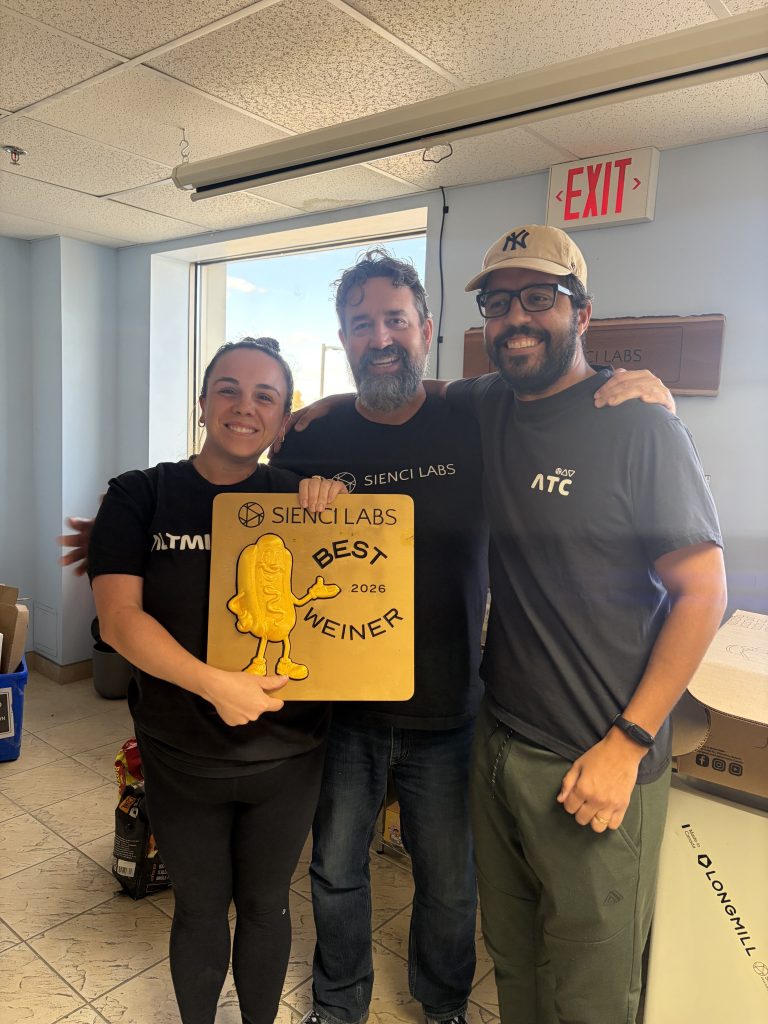
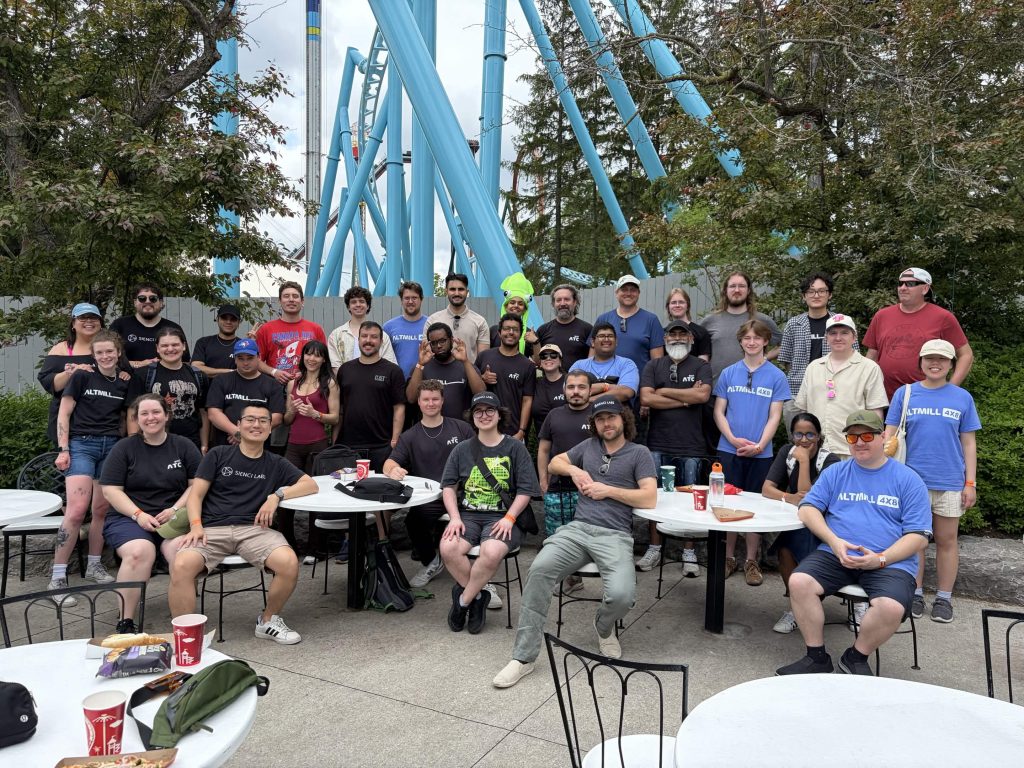
  • Celebrating Sienci’s 10 year anniversary with many familiar faces (this was a picture of some of our team from earlier in the year for Halloween)

The Wider Impact I’ve Seen

One thing I forgot to mention earlier is that, though we started Sienci with large ambitions, our underlying goal was to have as big an impact as we could on the hobby CNC space, and I feel confident saying that we’ve done that. This came from a place of what I’d call frustration, knowing what options were out there, how much people were being charged, and how unintuitive many CNCs were to use, we really hoped that we could at least become large enough in the CNC space that others couldn’t help but pay attention to what we were doing and follow-suit with improvements of their own.

All this is to say that I’m going to use this section to brag a little bit and be proud of our accomplishments. Please don’t take what I’ve written here as false attribution or an exhaustive list, this is simply my own list of what I believe to be unique ideas that I feel relatively confident that we either created or popularized in the industry:

  • Pushing down pricepoint on higher performance
    • I wouldn’t say we were necessarily the first to do this since much can be owed to projects before us like Shapeoko and OpenBuilds, but I do feel that our presence in the ‘second wave’ continued this push toward faster and higher build quality machines for lower costs.
  • ‘Baseless machines’
    • A philosophy we helped popularize with the idea being that we could save cost for many shop owners that already had money put into a sturdy table that they could mount the machine to, rather than paying extra for a separate frame, which has since been further adapted by others like Onefinity and FoxAlien.
  • Focus on strong community collaboration
    • This one is harder to gage, but I do feel strongly that one of our core company philosophies of keeping a very tight loop between community feedback and the planning of our next steps means that we’ve essentially been able to better empower the CNC community itself into having say over the future of what it wants to see.
  • Championing open source
    • We’ve always felt two things, first that people shouldn’t have proprietary lock-in to the hardware or software that they choose to use or spend their money on, and second that if we truly want to keep pushing the hobby CNC space forward then we shouldn’t be scared to share all our work out in the open for others to see and iterate on. The result I feel is a win for everyone, and I hope that more companies in our space would follow suit (though shoutout to other great ambassadors like V1E and Maslow), since we’ve now seen time and again the power and creativity that can come from enabling those within the community to keep moving towards the next steps in technology (something much more visible in the 3D printing space).
  • gSender
    • A sending software wasn’t the innovation here, I think it was just the relentless focus on both creating new features that made it feel like the CNC was smarter than it was, while trying to keep it neatly packaged up to be as intuitive as possible. In the early days we certainly got tidbits of inspiration from other senders out there, but I think now that we’ve found our footing it’s been very rewarding to see our novel work and efforts feed back into other senders like UGS, MillMage, ncSender, Genmitsu control, and the Redline controller. I think this will continue to be especially true after our recent 1.5.0 full redesign as there are aspects there that I feel so confident are the future of easier CNCing like our Configuration tab, Helper tool, and Machine Stats, but in the meantime here’s a list of some other specific concepts we brought to the table: touch plate continuity checks, start from line, file stream interruption recognition, seamless incremental-to-continuous jogging, rapid-normal-precise jogging presets, built-in grbl tool-changing support, workaround for full rotary axis control on vanilla grbl CNCs, maintenance reminders, background app waking stops computer falling asleep during cutting, triangle calibration tool, and a recognized CNCs list.
  • AutoZero
    • Still to-date the only touch plate I’m aware of that can probe nearly the full spectrum of common cutting tools.
  • SuperLongBoard
    • This project had to do with bringing the hobby CNC space into its 32-bit era as well as proving the usefulness of adaption systems that can upgrade older machines, and though there have actually been many that came before us, I do feel that our unique take of offering a user-friendly solution in an open-source and well documented package has been able to progress the concept much further.
  • Vortex
    • This is still not a solved issue, but we noticed two issues related to rotary/4th-axes in the hobby CNC space. First is that there’s certainly demand for it, and second is that it’s caught in a chicken-or-egg scenario where machine makers are waiting for easy-to-use software to exist and software makers are waiting for the machines to exist. I felt very proud to be one of the first to break this standstill and make the first step to put out an inexpensive rotary with many novel innovations like the quick-lock tailstock so that we could start to show demand, and we were all so happy once this started more momentum in seeing companies like Vectric be spurred to continue their work on improving rotary handling or Onefinity who followed suit with also releasing a rotary product.
  • AltMill, AutoSpin, upcoming ATC, and 4×8
    • This is now me putting the cart a bit before the horse since these are either still new to the market or pending shipping, but I do feel very excited and confident at all the unique things these new offerings will be bringing to the hobby market and really hope their impact will be large and widely felt. Pushing price-to-performance ratio on larger machines, offering essentially a spindle as nearly router prices, building so much more intelligence into a consumer ATC at such a low pricepoint, and bringing a 4×8 into the space also at an amazing pricepoint and still shipped through standard mail are all insane steps and I can’t wait to see what will follow next.

There were also a few other projects that I undertook or lead that maybe weren’t as game-changing but I’m proud to look back on accomplishing:

  • Co-creating the Mill One and LongMill V1
  • Leading creation of the LongMill V2, V3, V4, V4b, MK2, and MK2.5
  • Designing LongMill MK1 dust shoe, MK1 magnetic dust shoe, MK2 magnetic dust shoe, and MK2 dust sheilds
  • Creating/establishing Sienci’s whole resources documentation system/area, Facebook group, and User Forum
  • Designing and leading our novel software toolchain suggestion wizard
  • CAMLab (a foray into simplified, online CAM)
  • Establishing Sienci’s entire assembly instruction design language, colouring, and look and feel through many iterations over the years along with our approach to long-form, personable videos for assembly, tours, and updates

Thank You

#

Thank you for your trust in us when we were just a couple of people with a dream and a garage full of prototypes. Thank you for your patience when things broke, your excitement when things worked, and your belief that we were building something worthwhile. Thank you for every message, every photo, every project, every suggestion, and every moment you shared. This has been an amazing journey for me and has shaped me as an engineer, as a leader, and as a person.
I’ll carry these memories – both the good and the hard ones – into whatever comes next. Know that though I may be stepping away from Sienci Labs, I’ll always be cheering on each one of you, the continued success of Sienci, and the wider progression of the CNC space as a whole.

If I can also make one final request: if I missed anything in all my above recollections, please do let me know in the comments of anywhere this blog gets posted as I’d love to be reminded of it. Please also share any of your own experiences you’ve had with me, pictures of your setups, or any other way you’ve felt impacted as I’d be very grateful to carry that forward with me as a memento.

Be well, and continue to enjoy making and sharing,

– Chris

Ontario Safety Compliance for AltMill and LongMill Machines

Hi everyone, as you guys may know, we had been working with ESA on the safety compliance for the VFDs in 2025, which was eventually completed for sales in Ontario. We are now working with ESA on the compliance for power supplies used in LongMill and AltMill products within Ontario. For customers outside of Ontario, feel free to skip this notice, as this is only limited to within Ontario. If you are within Ontario trying to make an order for the LongMill or AltMill, you may receive a notice at checkout.

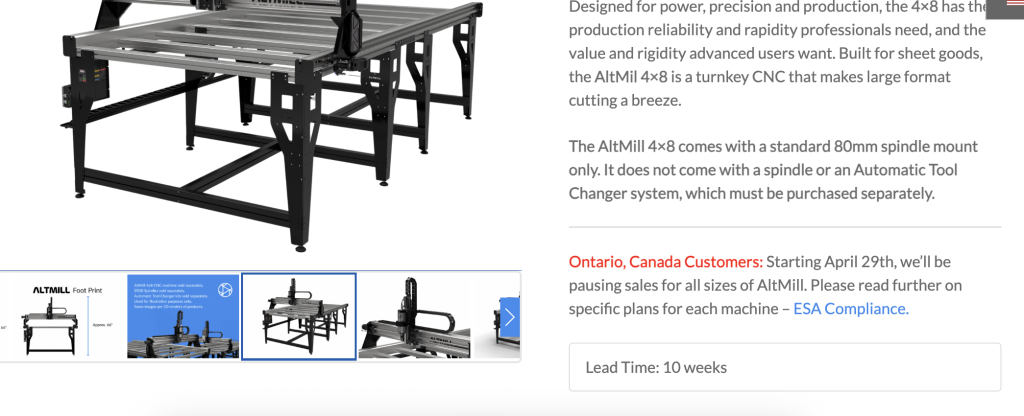
Starting April 29th, we’ll be pausing sales for the LongMill and AltMill for customers in Ontario. Please read further on specific plans for each machine.

LongMill MK2.5

Given that we have a small number of machines left for the LongMill MK2.5, it’s likely that we will be clearing out of this stock before having a prepared power supply. However, the upcoming LongMill MK3 which is expected launch soon, and will be safety compliant for use and sale in Ontario.

AltMill

Since we are expecting to continue production and development of the AltMill, we have been working on a new power supply design around the safety compliance over the last few months. Based on our development timelines, we expect this to be complete around August 2026.

What if I am in Ontario with an AltMill or LongMill already?

Based on our conversations with ESA and certification agencies, no current action is needed for users within Ontario. If any action is needed, we will contact you directly.

What if I am in Ontario and want to purchase an AltMill or LongMill?

Please contact us directly for additional support as we may be able to provide you with a one off power supply for temporary use that is safety compliant or hold your order until certified power supplies are ready to ship.

gSender 1.6.0 Release

Brand new gSender wow

After several months of Edge releases, testing, and community feedback, gSender 1.6.0 is here.

This release represents a large step forward for gSender. Much of the work throughout the Edge cycle focused on building out deeper tooling workflows, expanding controller capabilities in order to support newer versions of grblHAL, and improving performance and stability across the application.

A huge thanks goes out to everyone who tested the Edge builds and provided feedback along the way — many of the improvements below came directly from that input.

Below is a look at the biggest changes that made it into 1.6.0.

Firmware Compatibility

This release expands compatibility with newer grblHAL firmware cores. Updates were made across the communication and configuration layers to better align with recent firmware changes and ensure gSender can properly take advantage of all new features in more recent grblHAL versions.

These improvements help maintain compatibility as the grblHAL ecosystem continues to evolve, allowing gSender to work more reliably with newer controller firmware, updated settings structures, and additional capabilities exposed by newer firmware releases.

Performance and Infrastructure Improvements

Several foundational improvements were made for 1.6.0:

Faster Startup Times

Startup performance has been significantly improved in this release.

A number of internal optimizations were made to the application initialization process, reducing the amount of work that needs to happen before the UI becomes usable. These changes include improvements to module loading, background initialization, and general application startup flow.

In practical terms, this means gSender launches noticeably faster, especially on systems where startup time was previously a concern.

For many users the application should now feel much more responsive when opening, getting you connected to your machine and ready to work sooner.

Build System Improvements

The internal build pipeline was updated, resulting in:

  • Faster development builds
  • Smaller packaged application size
  • Improved overall maintainability
  • Mac silicon version now provided and added signing for both Mac releases

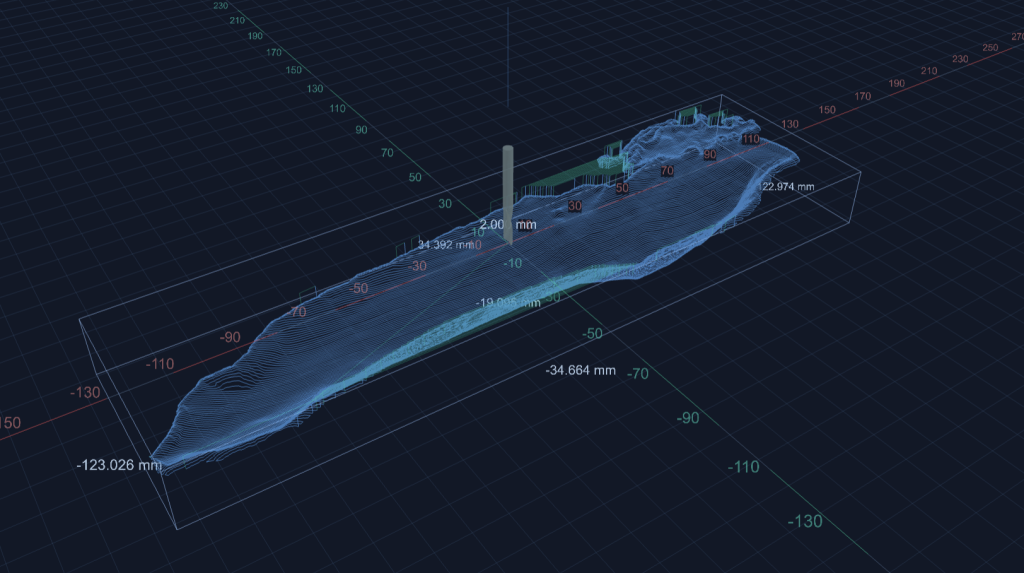
Built-in G-code Editor

gSender now includes a built-in G-code editor for inspecting and modifying files directly inside the application.

The editor includes:

  • Syntax highlighting
  • Search functionality
  • Quick navigation to specific terms or lines
  • Basic editing and saving capabilities

The editor also acts as an additional progress indicator while running jobs, highlighting which lines have been processed.
Editor

SD Card File Management

SD card functionality has been expanded significantly.
gSender can now interact directly with files stored on the controller’s SD card for grblHAL devices. It uses yModem protocol for USB connections, and FTP when connected over ethernet.

You can:

  • View files on the SD card
  • Upload files
  • Run files
  • Delete files

Files can be uploaded using drag-and-drop or file selection, making it easy to move jobs onto the controller.

When running jobs from the SD card, gSender now displays progress feedback similar to streaming jobs directly from the application.

SD Card Tool

Automatic Tool Changer (ATC) Support

One of the largest areas of work this cycle was full ATC workflow support.

gSender now includes an integrated system for managing tools, tracking tool changes, and working with the Sienci ATC more easily.

Tool Table

A new Tool Table allows you to manage all tool-related information in one place.

You can now:

  • Store tool offsets
  • Assign nicknames to tools
  • Probe individual tools or complete racks

This makes it much easier to maintain consistent tool setups across jobs.

Tool Table – now with easier nicknames!

Tool Timeline

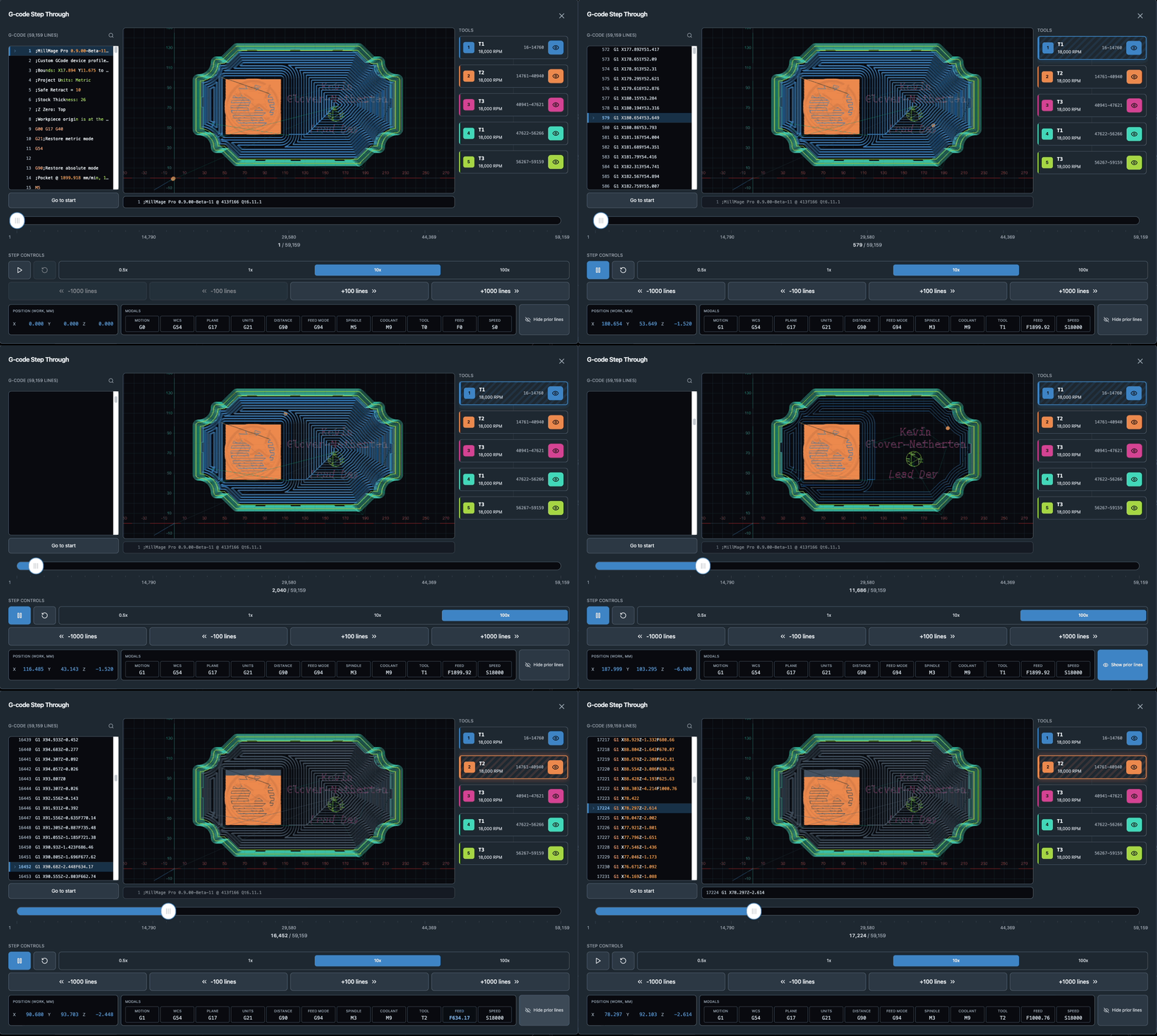
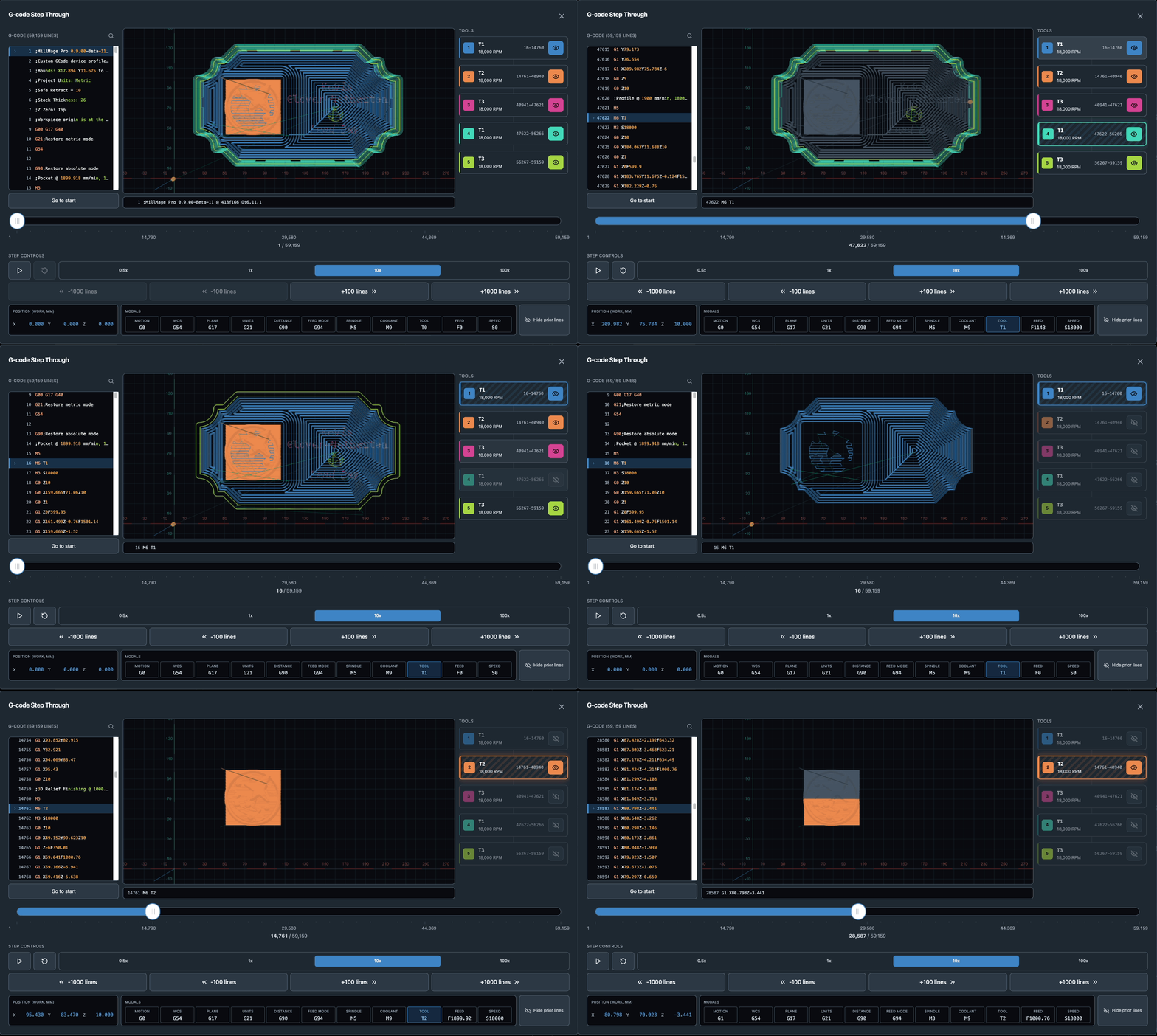
Tool changes during a job are now represented in a Tool Timeline, giving a clear view of when tool changes occur and which tool is currently active.

This helps users quickly understand multi-tool programs and track job progress more easily.

Tool Timeline

Tool Remapping

Tool remapping allows you to adapt a G-code file’s tool numbers to your machine setup without editing the file itself.

This is particularly helpful when:

  • CAM tool numbers don’t match rack positions
  • You want to run the same job with a different tool configuration
  • Tool racks change between jobs

Remapping can now be configured directly inside gSender before running a job.

Remap Dialog

ATC Workflow Controls

New controls were added to support day-to-day ATC operation.

You can now:

  • Load tools – both manually and using the rack
  • Unload tools – both manually and using the rack

These actions tie directly into ATC macros and make managing tool states much easier during operation.

ATC Widget

Accessory Installation Tool

To make getting started with an Automatic Tool Changer easier, gSender now includes an ATC setup tool that helps guide users through the initial configuration process.

The setup tool walks through the core steps required to configure an ATC system, including importing macro templates, defining rack size and behaviour, and writing the required configuration files to the controller’s SD card. This removes much of the manual setup that was previously required and helps ensure the necessary macros and configuration files are installed correctly.

The goal of the setup tool is to simplify the process of bringing an ATC system online, reducing the chances of configuration mistakes and making it easier for users to get up and running with automated tool changes.

We’ve already also implemented a spindle install tool, to help users with setting up their spindle accessory on arrival.

Improved Visualization

Visualization has seen several improvements in this release.

Rotary Visualization Improvements

Rotary jobs are now visualized more accurately, with fixes to geometry rendering and preview alignment. This provides a much closer representation of the final machined result.

Surfacing file no longer two straight lines

Tool-Based Visualization

Tool changes are now visually separated by colour, making it easier to follow complex multi-tool jobs directly in the visualizer. What colour represents which tool is indicated in the tool timeline.

Toolpath separation

Processed Line Display

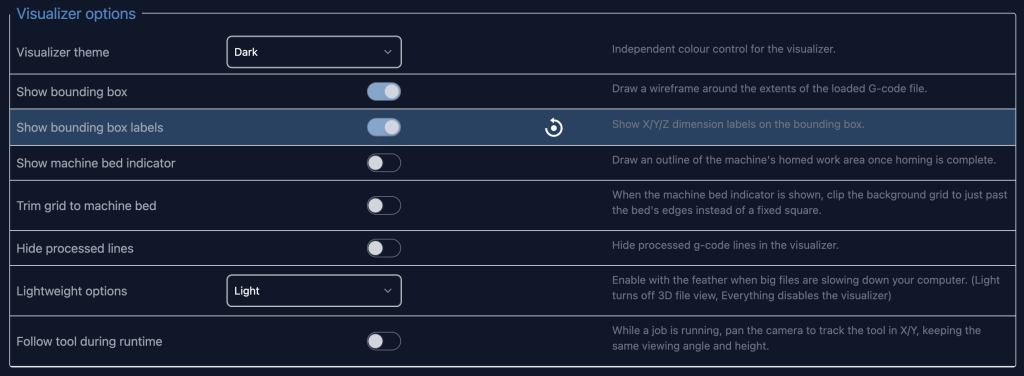
A new option allows you to hide processed lines entirely instead of greying them out.

For long jobs this can make the preview significantly easier to read.

Improved visualization speed

Visualization parsing had significant improvments on both speed and memory usage. The end result is that users should be able to visualize larger files faster.

Benchmarks indicate about a 50% increases in visualization and a 35% reduction in memory used.

EEPROM Editor

Advanced users now have access to a new EEPROM editor.

This tool allows you to:

  • View EEPROM values
  • Modify configuration parameters
  • Search for specific settings

This replaces the older legacy firmware tool and provides a more flexible interface for working with controller settings. You can find it in the Config section of gSender.

EEPROM tool in Config

Check Mode File Validation

A new Check Mode automation feature makes it easy to validate jobs before running them.

With this option enabled, on job load, you will be prompted if you want to check. If you select yes, gSender will:

  1. Enable GRBL check mode
  2. Run the loaded file
  3. Report any errors found

This helps catch issues before starting a real job.

Additional Improvements

Alongside the major features above, this release also includes a wide range of smaller improvements and fixes.

Some highlights include:

  • Custom Ethernet ports are now supported
  • Improved outline behaviour and new outline options (Rapidless square – generate a square that ignores G0 movements and just reflect cutting movements)
  • Ethernet auto-reconnect improvements
  • Better portrait mode space usage (larger buttons!)
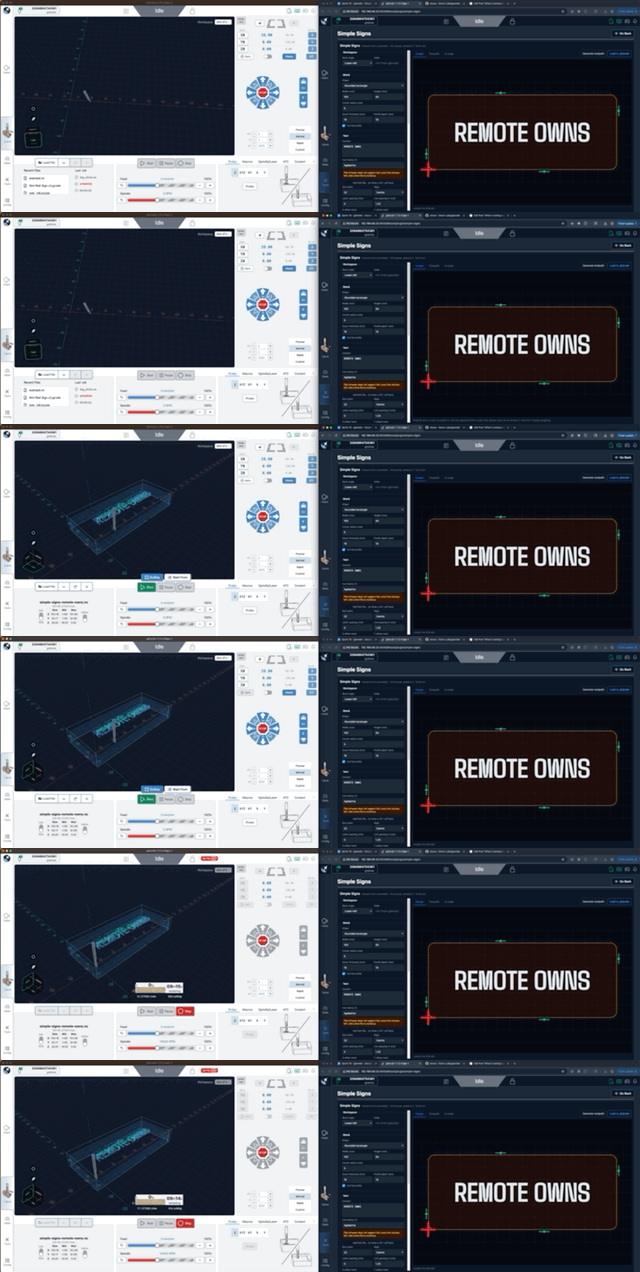
  • Remote mode – config is now accessible, settings are now synched between the main app and remote clients
  • Config tool performance adjustments
  • Improved job time estimates when feed overrides are active
  • Improved rotary job time estimation
  • Option to backup settings over specific time periods.
  • M0 / M1 pauses now properly display associated comments
  • Better application responsiveness on small resolutions
  • Better application responsiveness/use of space on portrait mode
  • Remote mode configuration access improvements
  • Updated library dependencies
  • Numerous bug fixes and stability improvements
  • Better Config reactivity when updating options that allow new options.
  • File associations so you can load a gcode file by double clicking it in your file explorer of choice.
  • Functions that require the machine to have been are disabled until homing is reported by the firmware for grblHAL devices.
  • Gamepad options and configuration updates – some new behaviours related to jogging.
  • A number of other behaviour and performance tweaks and fixes

Thank You

This release wouldn’t have been possible without the community members who tested the Edge builds, reported issues, and provided feedback throughout the cycle.

Your input helped shape many of the features and refinements included in 1.6.0.

As always, if you run into any issues or have ideas for improvements, we’d love to hear from you.

Download

https://github.com/Sienci-Labs/gsender/releases/tag/v1.6.0

April 2026 Production Updates

It’s another month, another production update!

Notes on customer service times

First off, I just wanted to mention that the last couple of months have been pretty busy on the customer service and support side of things, especially as we were coming down from our busy winter season, which meant that response times were a bit longer than usual. I’m happy to share that we did bring on another support person to our team with a lot of hands on experience being a former customer, which means we now have five full time staff for customer support, plus, some of our engineers and product management team also involved in the customer service and resource development.

We’ve now caught up on tickets and replying back on our typical timely manner.

With the AltMill 4×8, ATC, and a bunch of other stuff going through our pipeline, we anticipate our demand for support to continue to grow, so if you’re interested in joining our customer service team, feel free to share with us here: www.sienci.com/work

AltMill 4×8

Mike presents the upcoming timeline in the company townhall

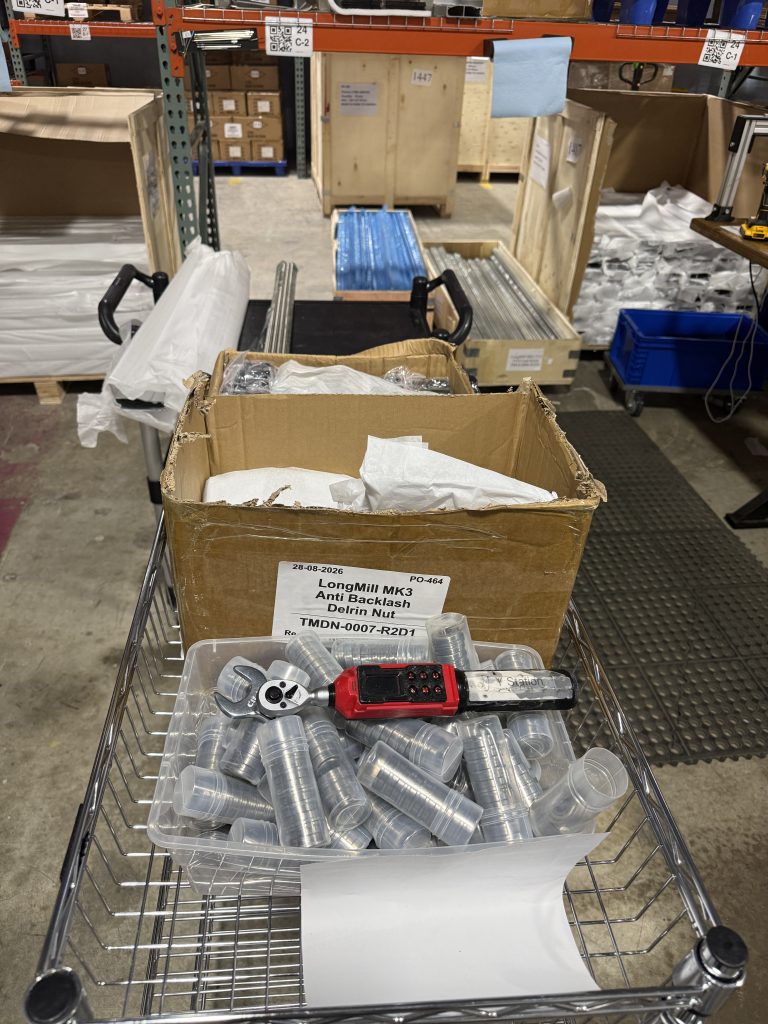
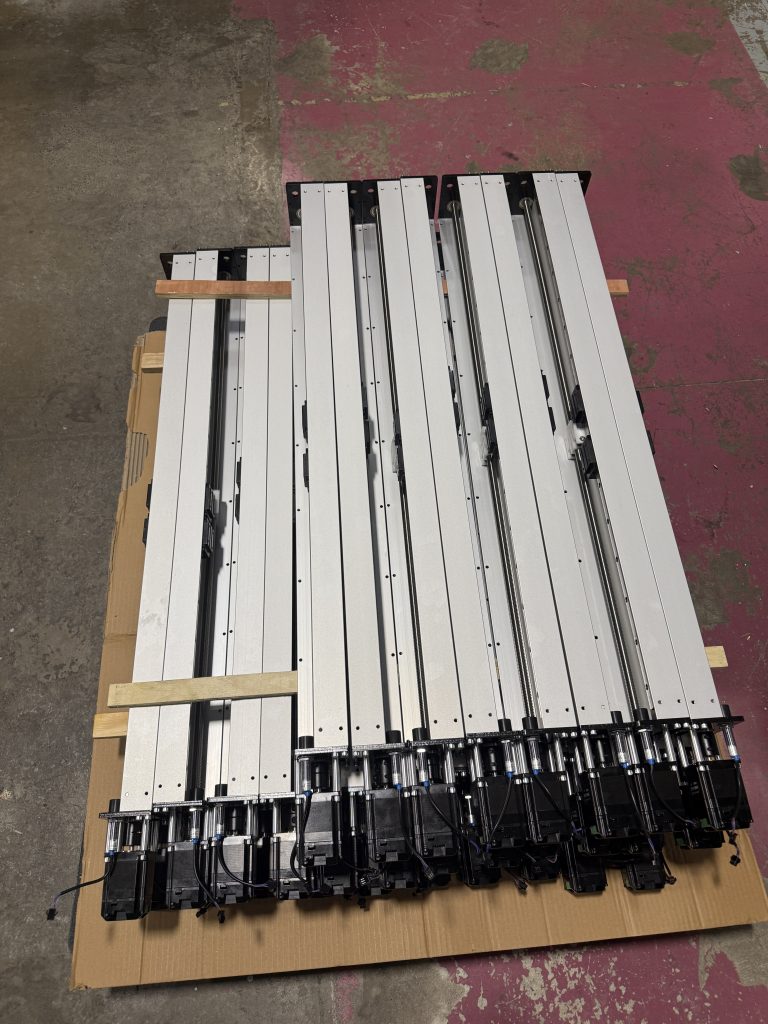
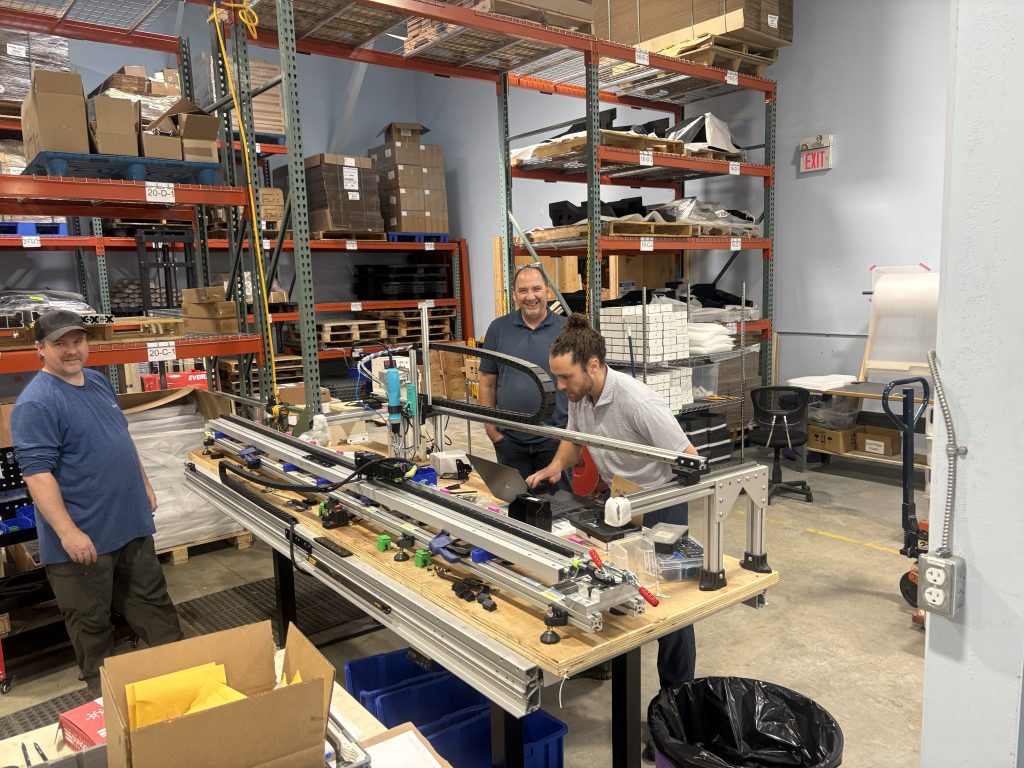
We have been full swing on AltMill 4×8 production, with a bunch of stations now set up for assembly of the new machines. However, we have been delayed a few weeks, and current first machine shipping date is set at April 10th April 17th. Due to some components being off tolerance and needing rework, we are putting extra effort to make sure that the first batch of machines don’t have early stage issues. Some things that are being addressed include:

  • Pitch error on the racks
  • Tooth profile tolerances on the pinons
  • Gearbox backlash

On the bright side, we have ordered enough extra parts so that even with a higher than typical number of QA rejects, we are able to fill a substantial number of the first batch. We are also working on remaking parts to ensure that we can complete the rest of the production batch. We are building and assembling as much as we can as we work through the process in the meantime.

We are also now in production of batch 2, bringing additional considerations and QA processes to reduce potential issues and delays.

In other news, the engineers and marketing team have been working on putting together the full assembly resources and videos over the last few weeks, getting ready to post once the machines start shipping.

Filming and creating content for the assembly process
Assembled units for the gearbox and swing arm mechanisms

LongMill MK3

A lot of work/progress so far with the LongMill MK3, with most of the work done around general testing and reliability.

We have now completed a round of rigidity testing to compare between the LongMill MK3, LongMill MK2, and the AltMill. Check out the results on our blog. (TL;DR) = the LongMill MK3 is between 65-80% more rigid than the LongMill MK2, signifying a big jump in performance.

In other news, we continue to work on the development and production of the LongMill MK3. We have now ordered the majority of the components needed, with the exception of controllers and power supplies which are still in development. Based on current timelines, we expect to open up pre-orders mid-May, and start shipping in and around July.

Deflection testing on the LongMill MK3

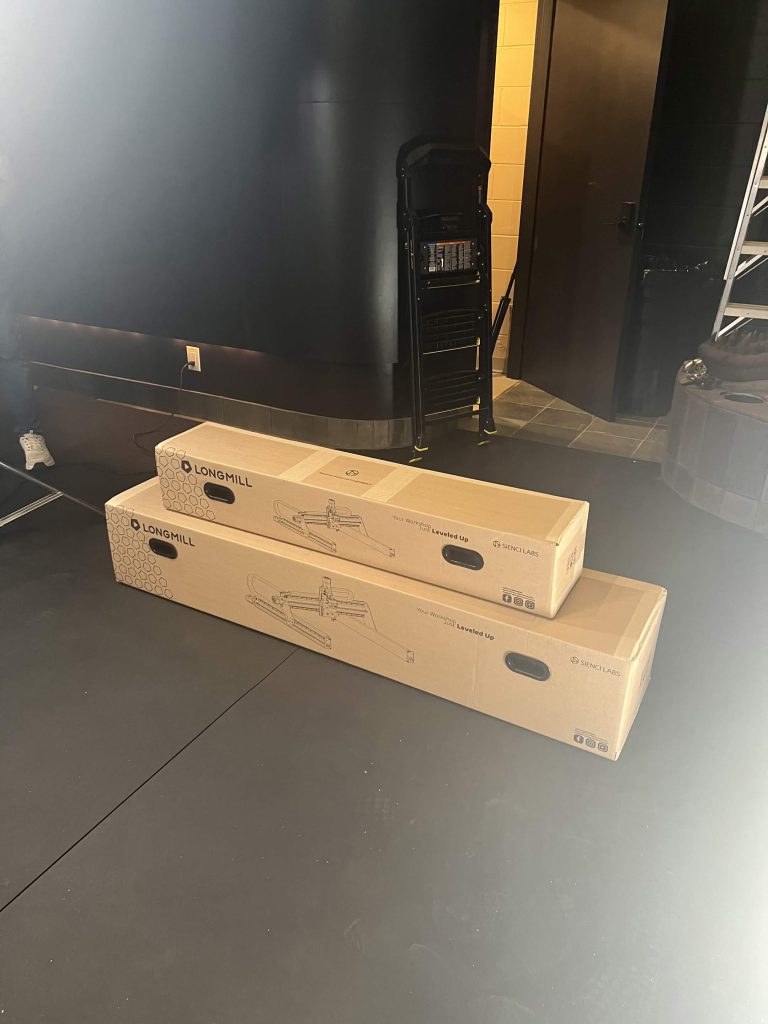
In other news, we’re clearing out of the last set of LongMill MK2.5s . We have around 50 of the 30×30 and 50 of the 48×30 in stock, so if you are looking to get one of those machines, they’ll probably still be available for the next few weeks before we sell out.

SLB-EXT V2 and SLB-LITE

We have made a few key decisions around the SLB family of controllers. First, naming:

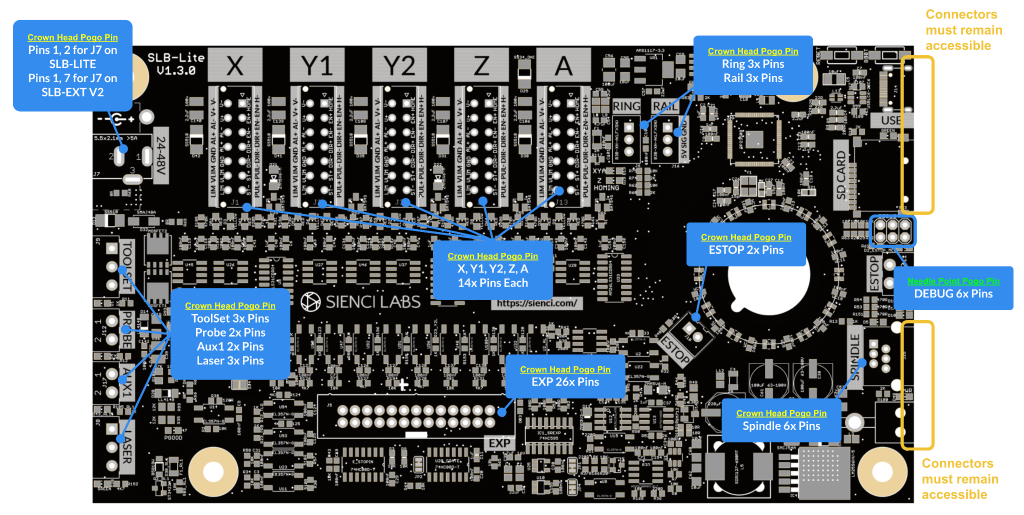
SLB-EXT V2: The new successor to the original SLB-EXT currently used on the AltMill. The SLB-EXT V2 is designed specifically for the AltMill and power handling of 48V.

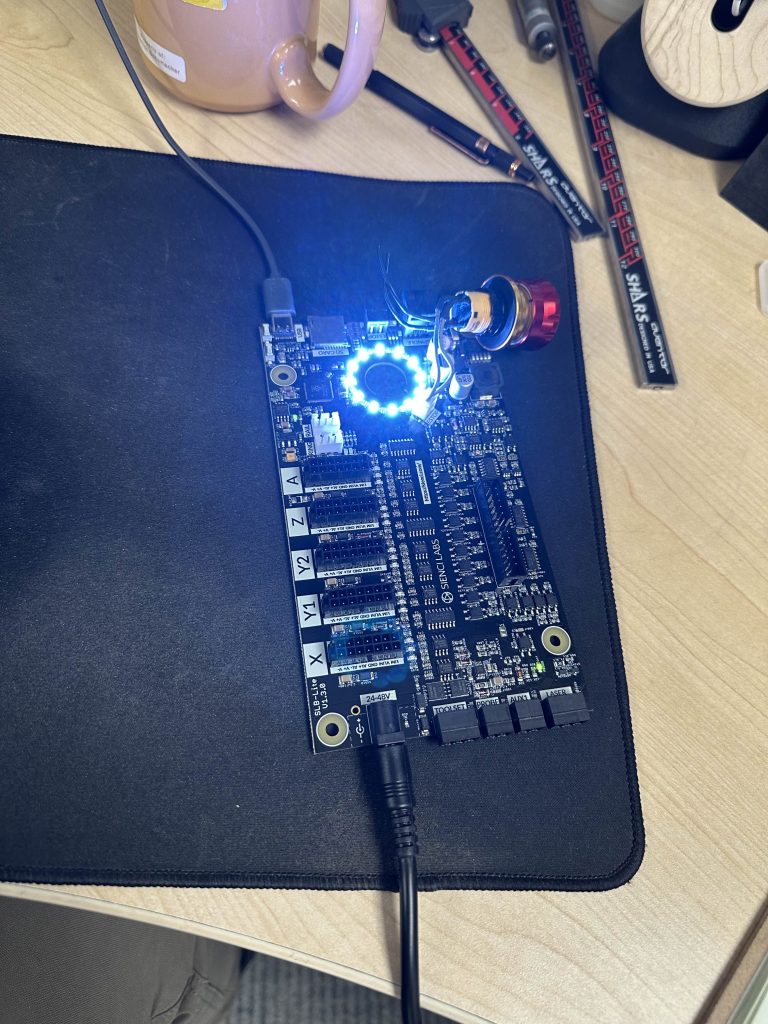
SLB-LITE: Designed specifically for 24V architecture of the LongMill.

Wire management with the new SLB-EXT case

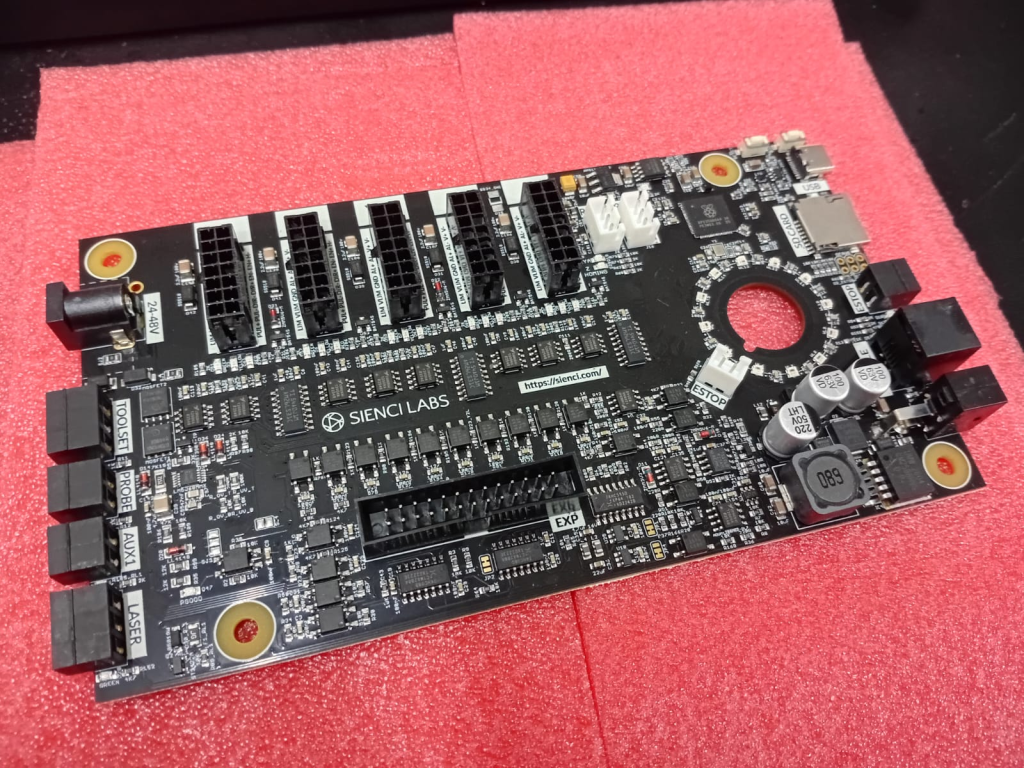
Our first prototype boards have been produced! We will go through initial flashing and testing of the new board over the next few weeks in April, and make revisions as needed before going into production.

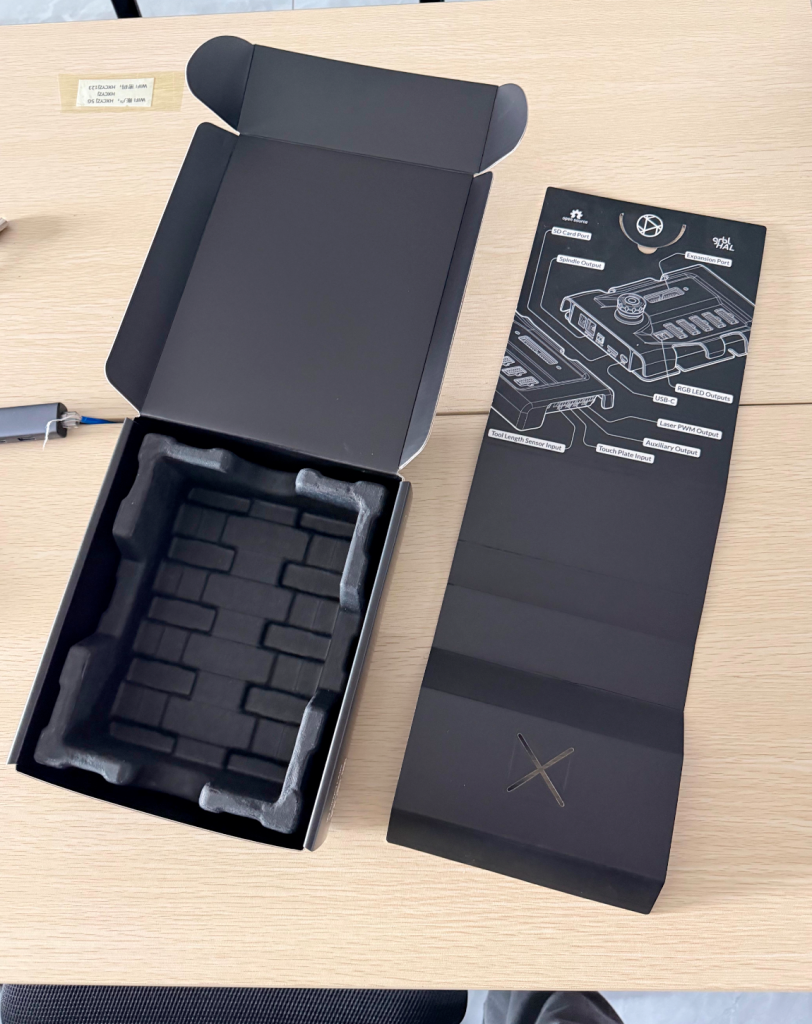
First prototype boards

Additionally, new molded cable samples have been made with a nominal width of 7mm, over our current nylon sheath design with a width of 10-12mm. Why did we unify all of the cables into one mold? Because:

  • Simplifies wire management
  • Makes wiring of the machine during the assembly process more intuitive
  • Allows more space in the drag chain for additional cables and accessories

Auto Tool Changer

The ATC production is now in full swing as we get prepared to ship out existing orders. We have set up production stations to start with assembly and we are building our first units now.

Unfortunately we are continuing to work on a few straggling details in preparation for shipping, and we expect that we will begin shipping in the third week of April. Some outstanding tasks include:

  • Completion of the resources and installation guides
  • Completion of the new firmware testing

Otherwise the completion of the hardware production and assembly for the first batch of ATCs are scheduled to complete on April 10th April 17th, in tandem with the 4x8s.

I’m also excited to share that we’ve also implemented a new station with the ATC to machine some aluminum parts in house. We’re expecting to slowly integrate more parts over time that we can machine in house to give us an opportunity to stress test our machines and products, as well as give us more production flexibility or adjust designs more quickly as needed.

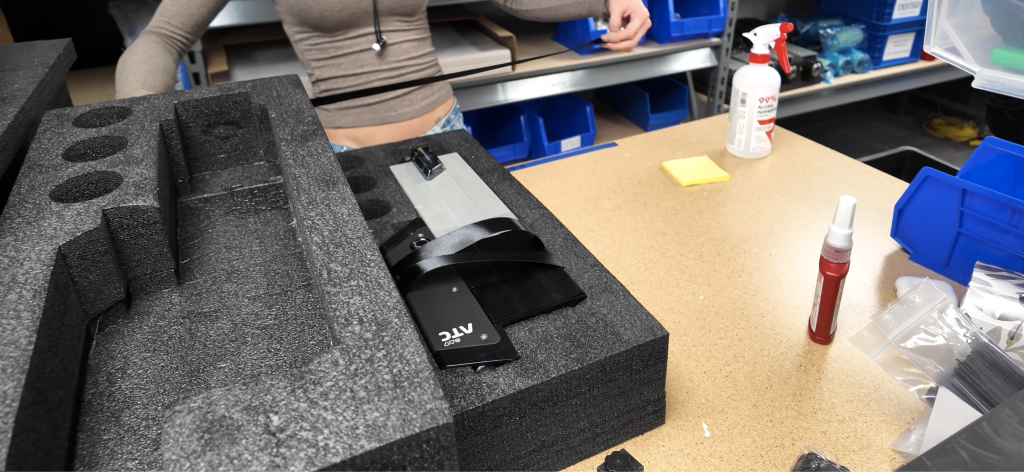
Nini prepping ATCs for testing
Ethan checking for Tool Rack defects with a jig
Next step is testing before shipment

Rigidity Testing on the LongMill MK3

Testing the amount of deflection a machine experiences at different loads, aka the rigidity, is a good way to predict the overall performance of a CNC machine. When it comes to using a CNC machine, two primary objectives are to make the part accurately and quickly. One major contributing factor to the precision of a part has to do with how much the end mill deflects away from the programmed path. The end mill on a more rigid machine will deflect less than on a less rigid machine given the same feeds and speeds, and thus produce a part that is more accurate. Alternatively, a user can run their machine faster while still producing a part of acceptable quality on a more rigid machine.

A diagram showing the effect of tool deflection and how it affects the geometry of a simple part

Perhaps a common example of how this affects a simple part of a CNCed design would be holes. Holes cut on a CNC machine tend to come out undersized, because the material on the walls of the hole push the machine and endmill towards the center.

It should be noted that deflection exists in all machines, it’s just a matter of how much. To improve tolerances, it’s common to do a “roughing” pass, which removes the bulk of the material, and then a “finishing” pass, which removes a small amount of material at the end, minimizing deflection to bring the part to final shape.

The state of the market & why we’re sharing results

As we discussed in one of our prior blog posts, there isn’t, as far as we can tell, a standardized method for testing machine deflection in the hobby CNC space.

We are able to glean general comparisons between our machines and other machines in the market by test results posted by other members of the community. As time has gone on, here are some of my personal opinions on why that is the case:

It’s hard to give context on what the rigidity numbers mean.

For most of the practical testing range, deflection is not visible to the naked eye. A lot of times, people will demonstrate standing on their machine as a demonstration of rigidity, maybe even standing on it while it’s cutting. This doesn’t really show how rigid the machine actually is, because you can’t see how much the machine is deflecting from a distance.

Additionally, just because a machine is bigger and heavier doesn’t necessarily mean that it has less deflection. Some areas of a machine’s design can affect the overall accuracy of the machine, even though it may seem insignificant at first glance. For example, from our comparisons between computer simulations and real life testing, we’re able to see that things like bolt tolerance and mechanical components shifting around under load can actually play a pretty big role in the overall deflection values. All this to say, you could have a super rigid machine, but have a weak or loose part of it, just that one part alone can have a major impact on the overall machine rigidity.

Rigidity is less important that we think it is.

Owning and using a CNC machine isn’t just about how rigid or fast it cuts. The whole experience is important, from the setup, assembly, software control, and overall reliability. For the average hobbyist, if a CNC project takes 45 minutes to cut instead of 30, does it really make a huge difference?

Return on investment in a higher degree of engineering requires high volumes to experience

Lastly, with us expecting to build a very high volume of CNC machines, a small design improvement affects a lot of users. For machines built at lower quantities or DIY machines, it’s cheaper and easier to over-engineer the machine rather than optimize it, since the cost of engineering time is higher than the cost of buying bigger or better components.

Testing process

We built a simple testing jig using old prototype parts from the LongMill MK3. We have a force gauge on the moving gantry and the dial indicator on the other. When we turn the lead screw to push the force gauge against the router, it moves the dial indicator some amount. The more that the dial indicator moves, the more the machine is deflecting.

Getting straight to the results & comparisons

As we can see from our results below, we have around 65-80% improvements in rigidity between the LongMill MK2 to the LongMill MK3. 

(Past Data and writeup for the LongMill MK2 from 2022.)

LongMill MK3 48×30
Force Applied (N)Force Applied (lbs)Positive X (thou)Negative X (thou)Positive Y (thou)Negative Y (thou)
255.624.5589
5011.2410101112
7516.8616151718
10022.4822212425
AltMill 4×4
Force Applied (N)Force Applied (lbs)Positive X (thou)Negative X (thou)Positive Y (thou)Negative Y (thou)
255.621111
5011.242343
7516.864455
10022.487667
LongMill MK2 48×30
Force Applied (N)Force Applied (lbs)Positive X (thou)Negative X (thou)Positive Y (thou)Negative Y (thou)
102.2482.8NA3.2NA
255.62~7NA~10NA
5011.2414.2NA20.7NA
Comparison at 25N/5.62lbs
Positive X (thou)Positive Y (thou)
LongMill MK2 48×30 (extrapolated)710
LongMill MK3 48×304.58
AltMill 4×411
Comparison at 50N/11.24lbs
Positive X (thou)Positive Y (thou)
LongMill MK2 48×3014.220.7
LongMill MK3 48×301011
AltMill 4×424
Comparison at 25N/5.62lbs
Positive X (thou)Positive Y (thou)
LongMill MK2 48×30 (extrapolated)710
LongMill MK3 48×304.58
Difference (thou)2.52
Difference (%)64.29%80.00%
Comparison at 50N/11.24lbs
Positive X (thou)Positive Y (thou)
LongMill MK2 48×3014.220.7
LongMill MK3 48×301011
Difference (thou)4.29.7
Difference (%)70.42%64.29%

Expected Loads

To get an idea of what sort of loads a machine will experience in cutting:

Basic glossary

Axial engagement (AP) = depth of cut

Radial engagement (AE) = stepover/width of cut

Linear feed (VF) = feedrate

Transverse force = forces perpendicular to feed

Feed force = force needed to push the bit through the material

Axial force = up and down (in the Z axis) forces

Generic ¼” end mill

For a list of recommended feeds and speeds for our general selection of end mills, please see our guide here: https://resources.sienci.com/wp-content/uploads/2022/10/FeedsSpeedsMetric.pdf

Settings based on recommended feeds and speeds

Settings based on recommended feeds and speeds

Same settings as above but with a 6.35mm step down

Same settings as above but with a 6.35mm step down

Same settings as above but with 6.35mm step down and 6.35mm step over (full slot)

Same settings as above but with 6.35mm step down and 6.35mm step over (full slot)

We will refer to some of these values in our discussion below.

Balancing machine performance and cost

Building a machine to be rigid and powerful is easy, but making a machine rigid and powerful on a budget is hard. To optimize the design of a machine, we take many factors into account. 

Acceptable deflection

As my electrical engineering professor used to say, in science, 5 = 5, but in engineering, 5 = 5, plus or minus a tolerance, which is to say, whenever we cut out a part, we should expect some deviance in the size of that part, and we need to decide and understand how much deviance we can accept. 

In the scope of woodworking, I believe anything under 0.005” (5 thousandths of an inch) to be “very very accurate”. For context, 0.005” is 6.25x smaller than 1/32”, or about a sheet and a half paper thick. 

LongMill MK3 48×30
Force Applied (N)Force Applied (lbs)Positive X (thou)Negative X (thou)Positive Y (thou)Negative Y (thou)
255.624.5589
5011.2410101112
7516.8616151718
10022.4822212425

If we look at the range of deflection at different forces, we can determine that we should aim to keep forces to under 25N to be within the 0.005” deflection range. 

Motor power

In our testing, we also measured the maximum force that the motor can apply to each axis. On the X axis (one motor), we measured the force to be around 600N, or 135lbs. On the Y axis, 256lbs.

Each motor must resist internal machine forces, such as the friction from the lead screws, bearings, and linear guides, as well as control the inertia of the machine itself. Additionally, the motor must push the end mill through the material at varying forces.

The mean and peak feed forces from Millalyser give us an idea on what those forces are (3.8N-10.4N). Based on these calculations, the motor forces are far higher than the expected loads from cutting.

A few notes:

  • We have 1.2NM motors on all axis, which will be the same as the ones used on the LongMill MK3 in production.
  • We used a 48V power supply, instead of a 24V power supply in production

Given how much more powerful the motors are, we believe that running the machines in 24V will not make a difference in overall performance. Because the 24V power supply and SLB-LITE designed specifically for the LongMill MK3 is significantly less expensive than the 48V architecture used on the AltMill, it makes sense to go down this route.

Spindle/router power

Through our AutoSpin T1 project, we did a significant amount of testing and research around spindle and router power, even going as far as building our own dynamometer to test true power output of different routers and spindles. Millalyzer also gives us an idea on the range of power draw needed from the router, ranging from 68.6 watts to 234.8 watts. 

The green line shows that the Makita RT0701 can push around 1600 watts of power until dropping down to around 350 watts of power at 32,000RPM. A typical 1.5KW spindle progressively increases power output as the RPMs get higher.

We can ensure that the spindle or router used with the LongMill MK3 is capable enough by comparing the estimated power draw from Millalyser to our measured output line. In either case, both the Makita RT0701 or 1.5KW spindle is more than capable of producing enough power. 

Our LongMill 1.5KW spindle kit costs around $650USD versus AutoSpin T1 is around $150USD, which is a 4x difference. Users can use either option, but we believe that the AutoSpin T1 is adequate for this application with the added benefit of the lower cost.

AltMill vs LongMill MK3 comparison

As it stands, the AltMill is approximately 2-4x more rigid than the LongMill. This is largely due to:

  • Thicker and heavier structure on the AltMill
  • Higher mass of the machine on the AltMill 

If performance and rigidity is very important to you, the AltMill does provide much more in that way. 

There are some practical considerations to make when it comes to actual differences in cutting, such as:

  • This is something I learned people call the “pucker-factor”, which is that people may not be so inclined to push their machine as hard as they can because of a lack of confidence.
  • Tools have a limit to how hard they can cut because they can deflect and break as well

Overall, I expect the practical cutting performance of the AltMill to be around 2x of the LongMill MK3.

If you’re cross shopping between the LongMill and AltMill, here are the prices to consider:

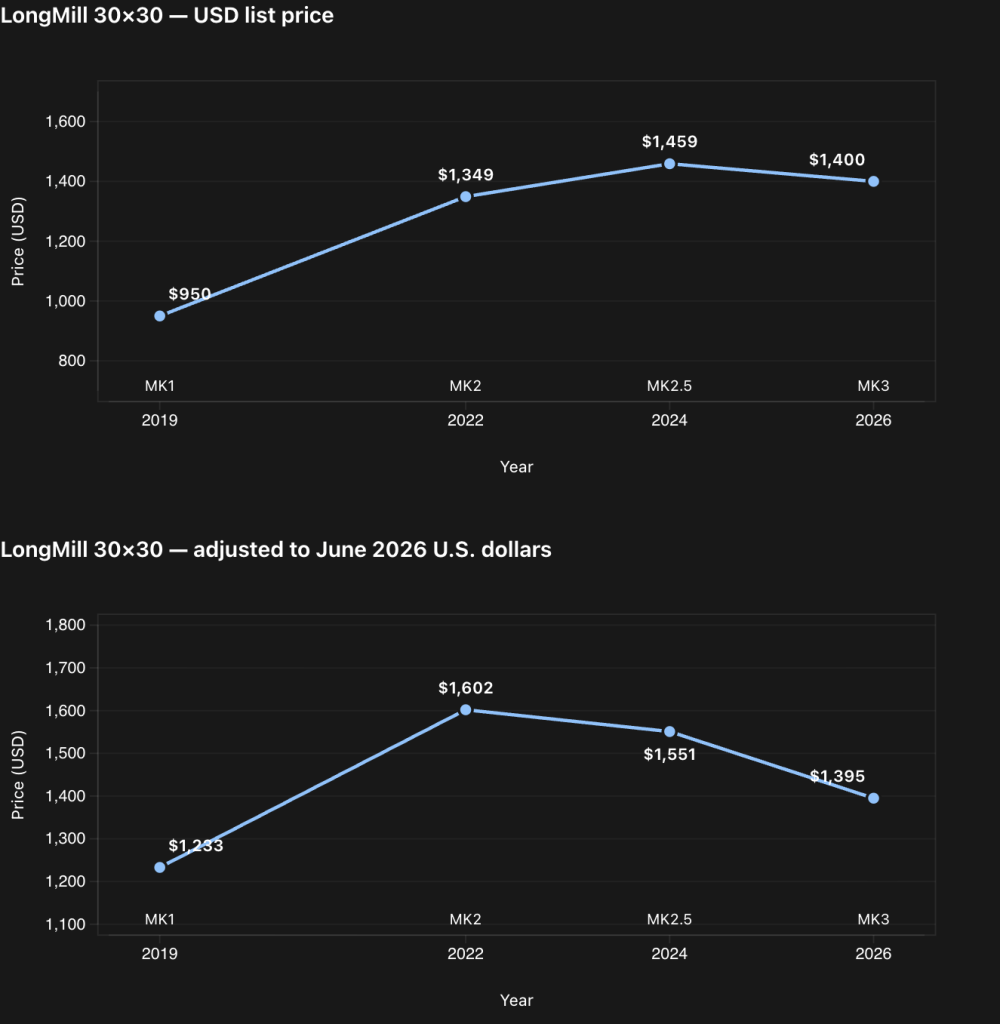
LongMill 30×30 ~$1390USD or $1870CAD

LongMill 48×30 ~ $1790USD or $2410CAD

AltMill 2×4 ~ $2790USD or $3890CAD

AltMill 4×4 ~ $3160USD or $4290CAD

…so between LongMill MK3 48×30 vs AltMill 2×4, which I think is the closest comparison based on working area, the price difference is around $1000USD, or comparing the 4×4, $1370USD.

We should also note that the AltMill also requires a spindle, larger tooling, and higher power dust collection to get the maximum performance, which can increase the cost difference when comparing between total setup costs.

Conclusions

With improvements to the machine rigidity and motor power, we expect users to be able to cut much faster and reliably compared to the LongMil MK1 and MK2. A significant amount of work and consideration has been made to improve performance overall while keeping the price the same as the older generation.

While this article only covered testing around rigidity, make sure to stay tuned on discussions of other improvements for the LongMill MK3, including easier assembly, maintenance, and electronics as well!

We hope you enjoyed this report on the LongMill MK3 design and performance!

March 2026 Production Updates

Hello there, welcome to our March 2026 Production Updates!

AltMill 2×4 and 4×4

Lead times for 2×4 and 4×4 machines are now fairly short, with most machines shipping out within 2 weeks. Lead times for 1.5KW and 2.2KW spindle kits may vary. 2.2KW spindles for the AltMill are expected to ship in approximately 1-2 weeks as well. 1.5KW spindles are backordered, and are expected to be restocked in mid-to-late April. We will provide a more detailed update on the product page once we have more details.

Orders for AltMill 2×4 and 4×4 will ship out separately, which means that users can assemble their machines ahead of time.

Office Expansion

We just expanded our office again! Mid-last year, our upstairs neighbours moved out so we took over around 6000sqft. There was also a part of the office with a stairway that lead to nowhere. Now, that stairway leads somewhere! We are knocking down that wall to take over a portion of our next door neighbour as well. This move adds another 2000-3000sqft, which will be used for some assembly work, especially for electronics, as it is more isolated to the larger office and we can reduce the amount of dust for those parts.

Painting the new office expansion

LongMill MK3 Development

LongMill MK3 development continues to chug along.

Setting up the first LongMill MK3 with Dave

We set up our first machine with our beta tester, Dave! Since he’s our first beta tester, we learned a few things, including:

  • Starting the Y gantries at the front of the machine makes it easier to put on the X rail, especially if you have limited access to the back of the machine.
  • Putting the X rail onto the Y gantry can be a bit finicky. We are potentially going to update the design of the Y gantries to allow the rail to drop in sort of like the AltMill.

Other changes and updates in progress include:

  • Redesigned Z-motor mount to allow the inductive sensor to sit higher up, allowing for more travel.

We are still looking to onboard and work with two more beta testers, which should happen in the coming weeks.

Prototype LongMill MK3 48×30

We are also slowly starting production on some of the major, long lead time components in the coming weeks.

Additionally, we are coming close to the end of the LongMill MK2.5 batch. Once we have sold out on the remaining machines, we will not have LongMills available for sale until the new batch of MK3 machines start shipping. We are currently checking inventory to confirm how much longer we have, but we estimate approximately 1-2 months of stock remaining currently. LongMill MK2.5 machines are shipping within a week.

SLB-EXT V2

The development of the new controller continues to be underway. For those not up to date, we are working on a new version of the SLB to be better optimized for cost and manufacturing, while still keeping the same functionality of the original SLB.

Continued development of the SLB-EXT

A ton more work done with the new SLB, including:

  • Updated layouts for the traces and components
  • Design and development of the advanced breakoutboard
  • Design of new plugs and cables to improve wire management

We will start the process of making a batch of prototype boards and conducting testing in the coming weeks.

Rendered mockup

AltMill 4×8

As of Feb 23rd, we have received all of the parts needed to start building 4×8 machines, with the exception of some screws and small straggler parts such as some allen keys, warning labels, etc. Much of the work is currently with testing and QA for incoming components, as well as working on the setup for the rest of the production area to get ready for assembly of major components in the next week or so.

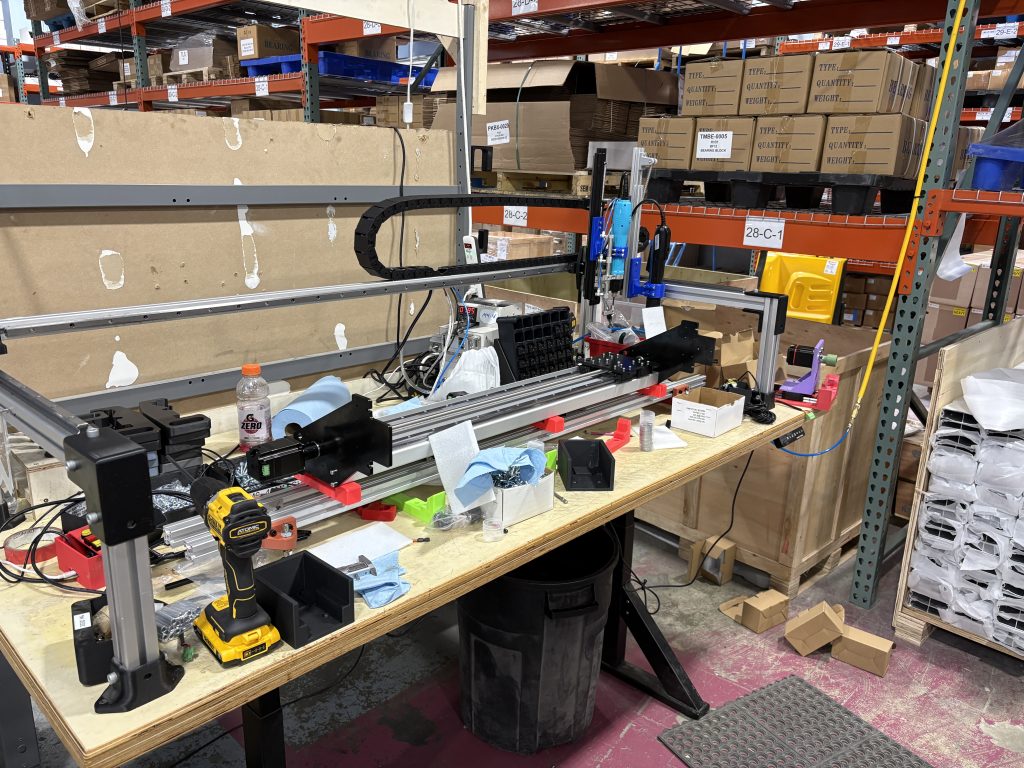
Mike with the 4×8 AltMill Y rail assembly station
Closer look at the AltMill 4×8 rack and pinion assembly station

Automatic Tool Changer

We have now received the majority of the parts needed for ATC production and are currently putting together space for the assembly and testing. We are expecting to start shipping out ATCs at the end of March, which will be a few weeks delayed compared to our original anticipated delivery time. Macros for the ATC, which are programs for controlling the ATC functionality can now be found online here: https://github.com/Sienci-Labs/atci_macros. We are also expecting to have updated versions of gSender plus online resources complete by shipping time, so the small delay is allowing us to get some of those things polished up.

#image_title

Clear Cut Dust Shoe

We’re excited to announce that the Clear Cut Dust Shoe is now available for sale! However due to higher than expected demand, the ~150 units we had stock were sold out within 24 hours, plus more with units that were sold with spindle kits.

We’ve put a pause on selling Clear Cut Dust Shoes individually for now, and we are currently working on ramping up production on that. We have a separate amount of stock for the spindle kits, so that we will ensure they are included on all of the spindle kits we ship on a 1:1 basis. We’ll have another announcement coming out soon to let everyone know the production schedule for the new dust shoes.

Informal Call for New Staff

I want to put some feelers out in the community for someone looking for jobs/roles in finance and HR. Up till now, we’ve/I’ve been managing this side of things since our company is not quite large enough to have someone fill this role full time, but given how things are going, I feel like we need to look in earnest for people to fill some of our company admin roles.

If you feel like you might be a good fit in a finance or HR type position at a startup or small company like Sienci Labs, feel free to send in an application here: https://sienci.com/work/

Oh also, we are looking for an electronics/embedded design engineer as well, so feel free to apply for that as well.

gSender Edge 1.6.0-Edge-4

gSender 1.6.0 Edge-4 is now out, bringing a solid round of improvements, fixes, and general polish.

We’re officially in the part of the Edge cycle where the focus shifts away from big new features and toward testing, optimization, and cleanup. A lot of this release is about making things faster, smoother, and more reliable based on feedback from everyone testing Edge so far.

If you’ve been waiting to try Edge, this is a really good time to jump in. As always, reports from early testers are extremely valuable.


Visualizer parsing improvements

This release includes a major rewrite of the file parsing and visualization worker used when loading G-code files.

Performance gains:

  • ~55% faster visualization time for most files
  • ~75% faster visualization for rotary files
  • ~35% less memory usage for typical files
  • ~86% less memory usage for rotary files

What this means in practice:

  • Bigger files load faster
  • Less RAM usage while previewing
  • Much better handling of large jobs

For reference, we successfully loaded an 85 MB / 5.5 million line file, which wasn’t possible in previous versions.

Large files visualize easily

If you want the full breakdown of what changed:

https://brash-elf-7d6.notion.site/gSender-Edge-4-Visualizer-Parsing-Improvements-30979195bff08056abcaf978c3db5cee


Connection and Alarm handling flow improvements

  • Connection process is generally smoother and more reliable
  • Better handling of reconnect scenarios
  • No resets in the connection workflow
  • Should reduce Alarm 14 and error 1s on connection and clearing alarms
  • We no longer assume ethernet is always grblHAL, so fluidNC/non-vanilla grbl users connecting over ethernet should properly fallback to grbl if configured as such

Responsiveness

  • Better support for smaller screens
  • Wide-but-short resolutions (like ~13xx × 7xx) should no longer cut off UI elements
  • Fixed some Remote Mode responsiveness regressions
  • Cleaner spacing in the top bar on smaller displays

Packaging

  • Fixed slow startup on AppImage builds caused by ASAR compression
  • Continued build pipeline cleanup
  • Smaller installs overall
    • Example: Mac .app size reduced from ~550 MB → <400 MB

ATC – status updates and other

  • Probed, unprobed, and off-rack/manual states are now separate statuses
  • You can always see both offset status and manual/off-rack state when applicable
  • Tool Timeline received a visual refresh for better clarity and information layout
  • Tool nicknames are now included anywhere a tool number is shown in the UI
  • Config and Templates moves into Accessory Installation Wizard
  • Extremely professional placeholder images added to ATC Installation wizard while we wait for marketing
New timeline look

New machine profiles & grblHAL Core support

  • Updated AltMill 4×8 machine profile
  • Added support for new/remapped firmware values and keys for grblHAL Core
  • Config automatically adapts based on firmware version
  • Affects EEPROM-related areas including:
    • Restore Defaults
    • Config Tool

Outline improvements

  • Outline process improved – should be faster, should work better for all types of files. Travel direction is always consistent.
  • Added new option – Rapidless Square – which computes a bounding box of only the cutting movements (G1/G2/G3) and ignores G0.
  • Can now configure outline to use custom feed rates and G1 rather than G0 (Thanks, kieraneglin)
  • Inner islands no longer considered when generating hulls for details outline – so file outline should be more consistent overall
G0 ignored, just outline cutting motions

Config updates

  • Various logic changes to config area to improve performance
  • You should notice the population of entries and search to be more performative
  • No delay when connecting on the config page

Various improvements & fixes

  • Selecting the current jog preset now resets values back to configured defaults
  • Config imports are validated before being applied
  • Diagnostic PDF now clearly shows when disconnected data isn’t available
  • Improved Run Check on Load workflow:
    • Prompts before enabling check mode and running the file
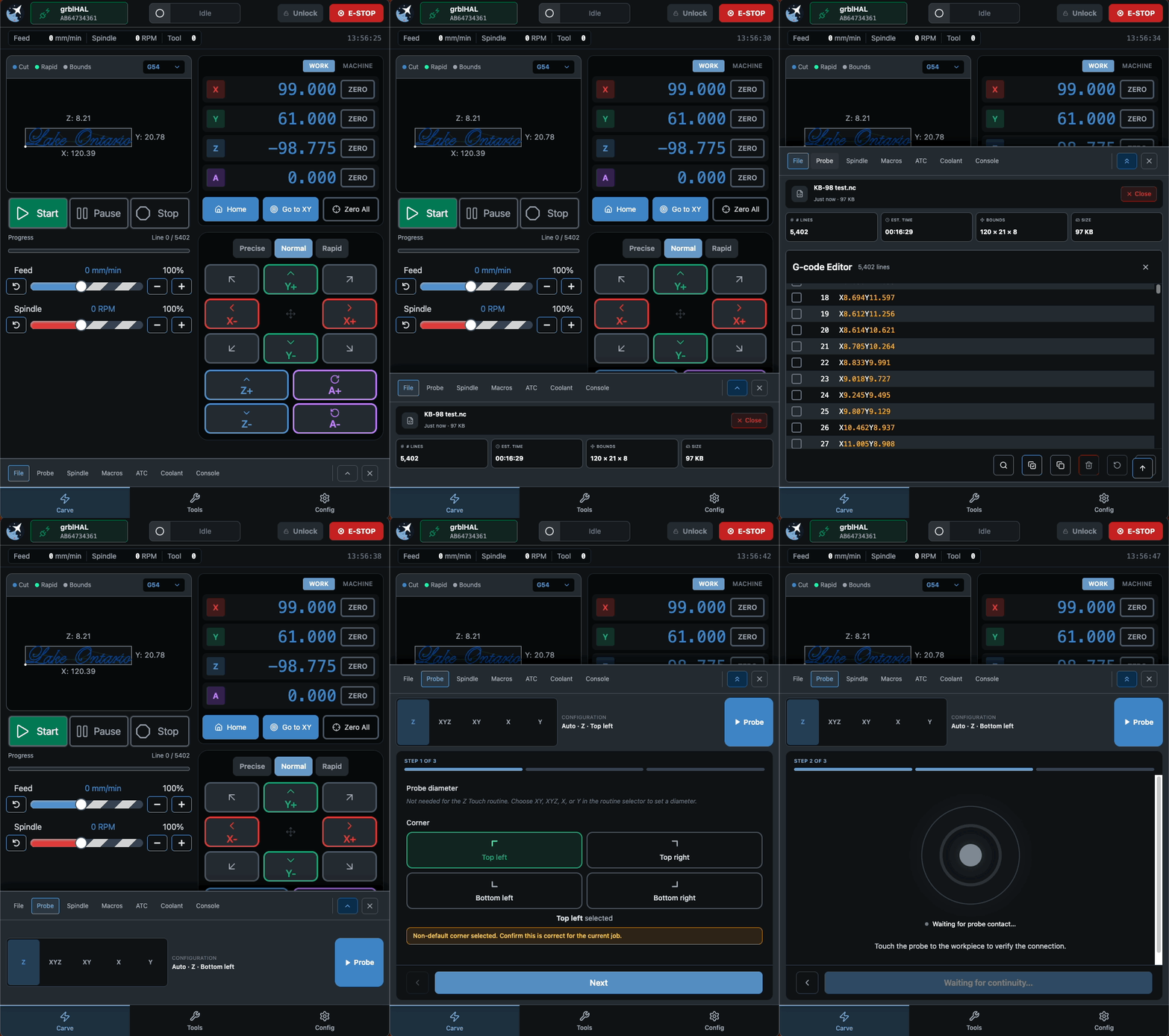
    • Probe corner can now be changed directly in the Run Probe dialog
  • Warning shown when using a non-default corner (no more probing the wrong spot)
  • Improved grblHAL flashing UX
  • Spindle selection now updates correctly when configurations change
  • Fixed connection widget interaction issues when dropdown menus are open
  • Alarm descriptions now pulled directly from grblHAL firmware
  • Various Dark Mode polish improvements
  • Fixed diameter parsing for DeskProto rotary files (for real this time). This must be toggled on inside the config section under “Rotary Diameter offset”
  • grbl Rotary – can now pass A through natively rather than always hijack Y when rotary mode switched off. This is mostly for compatibility with fluidNC/non-standard grbl variations that natively support A axis commands.
  • Camera cube added to visualizer in surfacing and rotary surfacing tools
  • No longer show the special animation for spindle/coolant when disconnected and spindle/coolant state is indeterminate

Download

gSender Edge is beta software, so expect the occasional rough edge. You can safely install gSender and gSender Edge side-by-side.

Huge thanks to everyone testing Edge and sending feedback — it directly helps shape the final 1.6.0 release.

You can find our Edge releases on GitHub:

https://github.com/Sienci-Labs/gsender/releases/tag/v1.6.0-Edge-4

February 2026 Production Updates

Hey everyone, welcome back to our February 2026 Production Updates!

10th Anniversary

AutoSpin T1 Has Launched

We’re excited to finally launch the AutoSpin T1! Learn more about it here: https://sienci.com/2026/01/20/everything-you-need-to-know-about-the-autospin-t1-router/

We received our shipment of approximately 2000 units on February 2 (it was supposed to be mid- February) and will get routers shipped out to customers shortly after.

AltMill 4×8 Production

We continue to wait and prep for the arrival of AltMill 4×8 components. Based on our schedules, the last remaining parts for the 4×8 are scheduled to arrive between Feb 20th to March 6th. Other parts are expected to arrive sooner, which means that assembly for the first units will start approximately mid-February, allowing us to make progress in advance before all parts arrive.

In other news, resources for the 4×8 assembly continue to be worked on, with filming for the assembly video scheduled for the second or third week of February in preparation for customers to start receiving their machines in March.

LongMill MK3 Development

Thank you all for the overwhelming response of applications for LongMill MK3 beta testing. We’ve now received the rails and started internal testing. We will be sending out beta testing units to selected individuals in the next few weeks.

First functioning prototype build of the LongMill MK3

As it stands, we’re super excited about the LongMill MK3 as we expect to bring a massive leap in performance over the LongMill MK2 and 2.5, while keeping it at a super competitive price point. Some additional work we’re doing to bring down BOM costs include:

  • An easier to manufacture, significantly improved dust shoe with easy to replace bristles. This means not only is the overall cost of the dust shoe less, but users can extend the life of their dust shoe by replacing just the bristles. We will provide users with extra bristle in each kit.
  • Integrated cables. With current cables being a combined bundle of motor signals, power, and inductive sensor signals sheathed in one nylon cover, we’re looking at molding a single cable to reduce the overall unit cost of the total cable.
  • SLB-Lite. With the SLB-EXT being a major cost in the total BOM cost of the LongMill MK3, development (see in the next section of the article) is expected to keep all of the core functionality of the SLB and SLB-EXT, in a smaller, lighter, and more affordable package.

SLB-Lite

In our discussion about the LongMill electronics, we mentioned, especially with the Closed Loop Stepper Kit, that the overall cost of the electronics currently makes up a significant portion of the LongMill MK3 bill of materials. This is primarily because the electronics were specced and designed for the AltMill. However, for the smaller and less power hungry LongMill, the AltMill electronics are functional but overkill for the application.

Peter and Daniel and have continued to work on the newest generation of electronics to act as the successor to the SLB-EXT used in the AltMill. We expect a number of improvements for the new controller, currently code-named “SLB-Lite”, including:

  • Lower cost, with the board expected to be around half the cost of the SLB-EXT
  • Improved wire management
  • Overall smaller footprint, allowing for lower shipping cost and easier integration into LongMills, AltMills, and other CNC machines.
  • Ability to use power supply voltages from 24V-48V and the ability to provide up to 100 watts per motor.
  • Ability to connect an additional board for added features and functionality beyond the SLB-Lite, while still being less expensive in combination than the SLB-EXT.

Lastly, by using the same controller on all of our CNC product lines, we expect to see savings through the economies of scale by essentially doubling the number of units produced. Plus we expect to reduce our inventory management costs with fewer unique components, and a more unified experience between the LongMill and AltMill lines.

Additionally, coming to all controllers is new SLB and SLB-EXT firmware, with overall performance and stability improvements, and specific features like faster and better handling of motor alarms and resetting, support for advanced plug-ins used for the Automatic Tool Changer, and unlocking of SD card features allowing for running gcode and files directly from the controller. More details on the new firmware and ability to have access to beta firmware before the wider launch available on our blog.

To coincide with SD card support, the upcoming gSender Edge (our beta version of gSender), will be coming out with the interface to communicate with the SD card. When both systems have been tested to be reliable, full support for the new firmware and all of the new improvements will come to the main version of gSender.

To hear Kevin talk about SD card support in the next gSender Edge release, check out this video here:

gControl Panel Computer Pricing Updates

Due to the recent RAM and memory shortages, pricing for the gControl has been increased. We are keeping an eye on the pricing for components as they change, and are hoping that pricing will come down soon. We will update pricing when RAM and memory prices come back to normal levels.

Certified VFDs are Now Shipping

After a long wait, certified VFDs have finally arrived and have undergone testing. Customers who are waiting on VFDs will receive them shortly.

ATCs Sells Out; New Batch Added

Due to higher than expected demand for the ATC, we have sold out of the first batch. Customers who place orders moving forward will be part of the second batch. The first batch is expected to start shipping in late March, and the second batch is expected to ship in June.

First look at production covers for the ATC.

Curious on how this whole ATC thing works? Check out Johann’s breakdown video here:

gSender Edge 1.6.0-3

gSender 1.6.0 Edge-3 now available!

gSender 1.6.0-Edge-3

gSender 1.6.0-Edge-3 is rolling out with a solid set of improvements and long requested fixes.

We are approaching the feature freeze for 1.6.0, so most remaining work before the March release will focus on stability, polish, and small behaviour adjustments. It’s likely we have one more Edge release that’ll prioritize various bugs and remaining improvements. If you have been waiting to try Edge, this is a good moment to jump in. As always, reports from early testers are extremely valuable.

This update includes several notable enhancements, including major gains in load time and improvements to remote mode.

Faster load and install times

Significant changes to the packing system and build process have produced much faster startup across all tested devices.

A load time of roughly 25 seconds or longer has been reduced to about 4. Similar improvements appear on every device, including gControl.

This has been one of the most common complaints about gSender, so we are pleased with the progress and expect further gains.

Check out the load time comparisons below:

1.5.7 on PC (~25 seconds)

Edge on PC (~5 seconds)

Edge on gControl (~7 seconds)

Installation is also noticeably faster.

Silicon Mac builds, Mac Signing, and new Electron version

We’ve updated the Electron version for packaging to the latest release, which means dropping support for earlier macOS versions. The minimum OS requirements are now as follows:

  • macOS: Monterey (v12, released 2021) and up
  • Windows: Windows 10
  • Linux:
    • Ubuntu 18.04 and newer
    • Fedora 32 and newer
    • Debian 10 and newer
  • We are building and providing both an Intel (universal) build and now a Silicon (ARM64) version of gSender for macOS. Silicon users should notice a performance improvement.
  • We are now also signing our macOS builds, so hooray! Coming soon to an app store near you!

Better portrait mode

We continue refining layout behaviour to make better use of space across different display configurations.

  • Larger, clearer buttons in portrait mode and elsewhere
  • Improved spacing and alignment
  • More adjustments planned throughout the Edge cycle
New portrait Mode sizing
New button sizing on the gControl

ATC installation tool / Accessory Installation Tool

A new guided installation tool walks users through setting up supported CNC accessories.

  • First supported workflow is ATC setup
  • Future plans include spindle, laser, and first time CNC setup guides

ATC configuration

The ATC configuration tool has been streamlined.

  • Combined and reorganized options
  • Improved flow and clarity
  • Updated interface for a smoother configuration experience
Look at all the options when it comes to ATC configuration

ATC Visualization and Tool Table

  • Updated colours to a designated set of 12 for better toolpath distinction. It’s now funky fresh
  • Tool table tool nicknames are now selectable from a database of common bits, which includes search and still the ability to type in a custom note for a specific T command.
New toolpath colours
Tool table – selectable tool database

SD and FTP support

  • FTP support added, allowing uploads over Ethernet instead of USB only
  • Simplified workflow with a single refresh/list button
  • Automatic SD mount attempts when the tool opens
  • Dark mode and portrait mode updates
  • Progress bar improvements
  • Safety checks to disable the tool when connected to grbl or grblHAL devices without Ymodem or FTP support

EEPROM and configuration improvements

  • Added support for new settings in the upcoming grblCore release
  • EEPROM tool now handles all reported EEPROM settings, not only those surfaced in Config

Rotary time estimation

Time estimation for rotary jobs is now more accurate. Travel distance calculations now correctly account for A axis rotation, bringing estimates closer to real world results. Accuracy is approaching within 10 percent, with more refinement planned.

Some of the test file results for new rotary estimation

Visualization for rotary files has also improved. DeskProto typically sets Z to the surface and stores workpiece diameter in comments. gSender now uses that information to produce correct visualizations. Most gcode viewers cannot do this without explicit diameter data, so this is a meaningful improvement.

Better Rotary Visualization

Visualization matches end results

Remote mode

  • Updated look and feel
  • Settings now sync between desktop and remote clients, ensuring consistent preferences such as jog speeds, probe type, and units

Gamepad Updates

  • Fixes to certain shortcuts on gamepad firing twice, specifically the park button and probe popup
  • Added a new feature to disable dynamic speed and use a fixed value for thumbstick jogging
  • All these changes were done by a community member. Thank you for your contribution Kesmit13!
Fixed speed mode

Various fixes and improvements

  • ATC functionality updates
  • Fixed issues where tool offset was being incorrectly zeroed out on board reset
  • $SpindleESH now sent correctly on spindle select for core firmware
  • Gamepad jogging improvements, including fixed speed jogging
  • TLO probe offsets captured mid toolpath to keep UI elements current
  • Error and Alarm descriptions populated by grblHAL firmware
  • Helper accessible across all gSender tools, not only the carve page
  • Optional prompt on program close to prevent accidental exits
  • AltMill 4X8 machine profile added
  • Now using grblHAL error and alarm descriptions throughout the application
  • AltMill ZxY plus Spindle configurations removed
  • Added probe profile for BitZero 2 probe block (thanks Krudoy)

Download

gSender Edge is beta software, so expect occasional instability. You can install both gSender and gSender Edge side by side.

Thank you to everyone testing Edge and sending feedback. Your reports help shape the final 1.6.0 release.

You can find our Edge releases on GitHub:

https://github.com/Sienci-Labs/gsender/releases/tag/v1.6.0-Edge-3

Call for Beta Testers: Moving to the Main grblHAL Firmware Branch

Hey everyone!

It’s been a little while since we’ve talked about what’s going on under the hood of the SuperLongBoard (SLB), and today we’ve got some exciting news for those of you who like to live on the bleeding edge.

We are looking for a small group of AltMill and LongMill owners to help us beta test the new “Main” version of the grblHAL firmware.

If you’re interested in helping us test this out, you can fill out the Google Form linked at the bottom of this post. But first, a little history lesson on how we got here, why this change matters, and what you can expect.

A Quick History Lesson: SienciHAL vs. Main

When we first launched the SLB, we made the decision to fork the firmware into our own specific flavour, which we affectionately called “SienciHAL.”

At the time, we needed to make sure the firmware was rock-solid and perfectly tailored to the specific hardware we were building. We needed to guarantee stability for our users right out of the gate, and having our own branch allowed us to lock things down and ensure everything behaved exactly how we wanted it to for launch.

However, maintaining a separate fork means you miss out on all the cool new stuff happening in the wider world of grblHAL development. Over the last year, we’ve been working closely with the original creator of grblHAL (Terje) and the community to bring our specific needs and features into the Main branch of the firmware.

Our goal has always been to contribute to the open-source ecosystem, not just take from it. By working to get our changes merged into the main project, we ensure that the SLB remains compatible with future developments while being able to contribute any potential improvements back to the community.

What’s New in this Firmware?

For the most part, if we’ve done our job right, you won’t notice a huge difference in how your machine cuts. The motion and reliability should feel just as solid as before. However, moving to the Main branch unlocks some nice quality-of-life improvements and future-proofing features – examples being:

Automatic Motor Alarm Reset: One of the small but mighty changes. It makes recovering from motor alarms much smoother without needing to power cycle or mash reset buttons as frantically.

SD Card Support: We are unlocking support for SD card reading, which opens the door for running files directly from the board and other advanced standalone features down the road.

Advanced Plugin Support: This firmware includes support for the plugins we’ve developed for our ATC (Automatic Tool Changer) spindle. We also hope that these features will be helpful for anyone setting up their own automatic tool change system on any machine running grblHAL.

Under-the-hood Tweaks: A lot of small improvements to stability and code efficiency that come from the collective brainpower of the open-source community. This firmware version also exposes the ability to change many other settings and features such as LED brightness and ‘jerk’ motion control.

Who Should Test This? (And Who Shouldn’t)

We are looking for AltMill and LongMill users who are relatively comfortable with flashing firmware and using gSender.

This is beta firmware. While it has been tested to the best of our abilities and equipment, there is naturally a risk of bugs or unexpected behaviour.

It is not recommended to participate in beta testing if you’re in the middle of a critical production run or have a deadline to meet.

DO sign up if you enjoy tinkering, don’t mind providing feedback, and want to help us polish the next generation of our software stack!

For Interested Beta Testers

If you’re interested in beta testing, please fill out the Google Form below. We will be selecting a limited number of users to start with to ensure we can provide adequate support and gather focused feedback. If selected, we’ll email you the firmware file and instructions on how to flash it to your SLB.

For Everyone Else Interested

For anyone interested in upgrading without beta testing, an officially supported public release of the new grblHAL main firmware will be made available in the coming months, shipping with new machines as well. We will announce this in a subsequent blog post and on social posts.

We’ve also been working to coordinate to have a ‘Webbuilder’ accessible grblHAL machine profile accessible that will allow advanced users to configure their version of this firmware any way they’d like to.

We are incredibly grateful for open-source projects like grblHAL. They are the backbone of what makes affordable, high-performance CNC machining possible for hobbyists and small businesses. We want to do our part to support and contribute to these projects wherever possible, and moving our users to the Main branch is a huge step in that direction.