Hey everyone. We get a lot of questions about software for CNC machines, part of which includes using a g-code sender or machine interface. If you’ve ever gotten technical support from us, there’s a good chance you might have talked to Kelly, who took some time to make this video to help answer the common questions and discuss common functionality in the software.
This video covers some of the basic features that are in g-code senders like UGS and our very own gSender.
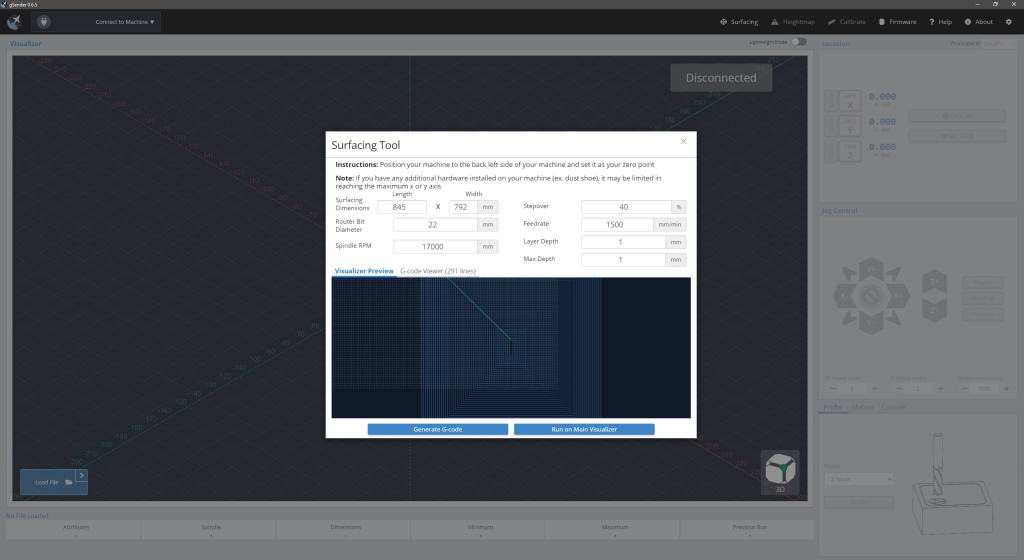
Our development team have been working hard to continue making gSender better. Our latest update improves overall performance and reliability, as well as working on new features. The latest version now comes with a surfacing tool that makes it easy to surface your wasteboard using the built in tool.
This tool lets you import your basic settings such as your tool size and speed to automatically generate the toolpaths to run on your machine. Not only can you use this to surface your machine, but you can also use it to surface other stock by changing the size on the tool.
If you aren’t on the latest version of gSender, your gSender program will have a green arrow to indicate an update is available on the upper left side where the gSender logo is.
Additional gSender Documentation continues to be in development. Feel free to check it out to learn more. Continue to stay tuned as more changes and updates come to gSender!
This is a really big milestone that I’m really excited to have reached! It’s not easy or inexpensive to be paying nearly 4 peoples salaries for coming up on 5 months just to develop a program that is being made available for free but we just really think that this labour of love is going to be something that benefits not just the LongMill community but the Hobby CNC community at large.
So I guess now is the time for me to answer the two big questions:
Why now? Though the changes between our release last week and this week aren’t drastic it’s never really clear cut when something is ready to move onward. Since this was my call, I can say that I didn’t want to make gSender public until I was sure that we had all our bases covered. This included at least a couple of iterations on builds for every OS, less reports of crashing and bugs, fulfillment of the big-ticket item requests like jogging stability and keymapping, and some refinement in the overall design that was more of a gut feeling.
How does this include the hobby CNC community as a whole? If you weren’t aware, the LongMill and many other machines such as: X-carve, Shapeoko, Bob’s. MillRight, OpenBuilds, 3018 CNCs, and more all run on the GRBL open-source firmware. This is what gSender has been built to support. This means that though gSender comes ready out-of-the-box to run a LongMill, it can also readily support many other kinds of CNCs and we’ve made it open-source and free across the board so that anyone can come on over, grab it, use it, and benefit from it. So yeah, tell your friends! No mater what CNC they use, if you’ve enjoyed using gSender then they probably will too 🙂
Alright so, of course I’ll do a quick recap of changes since the previous release and where to download, I just want to say a couple last things first:
With gSender now public, this will likely be one of the last communications made to this mailing list as all of you signed up for the duration of the closed Beta which is now concluding. Instead, I’ll likely be moving my communications over to a combination of our website blog and the Forum – we’ve got the regular Sienci Mailing list you can feel free to sign up for if you want to continue receiving development notifications
If you’ve enjoyed using gSender, I’d love it if you would take the time to respond back a review of how you find it. I don’t yet have a plan on how I’m going to use the reviews but at the least me and my dev team really grin ear-to-ear when we see you guys getting so much out of gSender so that would be some great feedback to hear
Lastly, thank you all so much for taking the time to provide your feedback – the feedback that’s brought gSender to what it is today. There will continue to be a page available for submitting gSender feedback here: https://sienci.com/gsender-feedback/ so keep it coming if you have more to say. I’m so grateful for the time and words from all of you
Okay, on to the normal stuff!
New changes:
Improvements to job handling
Tooltips created for data entry points
Splashscreen tweaks
Working PI build!?
Downloads: All downloads are now available on the gSender page on our website, check them out here! https://sienci.com/gsender/
If anyone has any further questions or need assistance downloading the new version I’ll be keeping my ear to my inbox and the gSender forum category over the weekend
Cheers cheers cheers! -Chris and the rest of the team at Sienci Labs
I decided to write this post to talk a bit about routers to use on hobby CNC machines like the LongMill. If you’ve done some research on this topic, you’ve probably seen a lot of machines use the same Makita router. Of course this isn’t a coincidence. We believe that the Makita RT0701 is a great option for a lot of reasons, including:
Good speed control from 10,000 to 30,000RPM
Simple round body which makes it easy to mount to a machine
Affordable price of around $100 to $150
Easy to find at most big box hardware stores
Ample power and performance
However, for a lot of people, especially woodworkers who use full size routers that have 1/2″ shanks and +2HP motors in their work , the Makita router looks a little bit dinky. If you’re one of those people who have this opinion, here are the reasons why the this router is more powerful than you might think.
Electronic speed control
By far the biggest reason the Makita punches above its weight is because of the electronic speed control built into the router. Simply put, when the Makita’s motor is under load, the electronics will boost power to the motor to compensate. This means that no matter how hard you’re pushing the router, the motor will continue to spin at a constant speed. For CNCing applications, this is an important feature as the speed of your router is closely tied with the speed and quality of your cut.
Although many routers now come with this feature, routers that do not have electronic speed control need to rely on their internal inertia to keep their RPMs stable. Although this works in an hand held application, CNC machines need to have a consistent speed through all of the cuts for the best results.
If you have a router that doesn’t have speed control, you’ll likely notice that your RPMs drop when you hit the material, and you have to adjust the pressure of your cut to keep cutting consistently. With a router like the Makita, the router will instantly compensate for the change in load and not allow the RPMs to drop.
Matching the performance of your router to the performance of the machine
With almost all hobby CNCs, the deflection of the structure of the machine is the limiting factor. To put simply, the machine will deflect far enough to ruin a cut before the router will begin to struggle to keep up, which means that there is no point in putting a larger router that will never see its full potential.
Our real life testing
Over the last couple years, we’ve heavily abused our Makita routers, such as by cutting large amounts of aluminum and wood at a time. We do run tests as well that involve crashing the machines while the Makita is still running to test the effects of changes in the electronics which can completely stall the router. We also have built custom industrial-focused machines that use the same router. Here’s an example of a project where we used a Makita router to cut aluminum.
Some of our tests include cutting through upwards of half an inch of hardwood using our 22mm surfacing bits to stall the router.
I hope this post provides a bit more confidence in the Makita routers and answers some questions on whether a larger router is needed for the LongMill.
We’re happy to announce that lead times will be dropping from 3-5 weeks to 2-3 weeks!
*UPDATE – We have now cleared our backorder. New orders will ship within one week!*
This comes due to a flattening out in the number of orders we are getting, as well as the additional staff that we’ve brought on to continue packing and shipping machines. We are aiming to keep our lead times within two weeks, however, we are stating our lead time as 2-3 weeks to provide ourselves an additional 2-week buffer for any unforeseeable delays.
It’s exciting to finally get back down to our 2-3 week lead time, as we have seen a major backlog of orders since around June of last year and it wouldn’t have been possible without the hard work and dedication of the Sienci Labs team. As our production capacity meets the demand for the LongMill, this gives us the opportunity to dedicate more time to developing other parts of the company such as marketing, customer support, and technical development. We also expect to see improvements in the productivity and efficiency of our production, giving us more flexibility in the number of machines we can sell and ship.
At the time of writing, we have around 270 machines in stock. We expect to keep our lead times at around 2 weeks until we run out of this stock.
Batch 5 production
We are currently shipping machines for Batch 4 and are producing parts for Batch 5. Parts for Batch 5 will be arriving between May and June. Once we run out of parts for Batch 4, new customers will need to wait for all of the parts in Batch 5 to arrive for us to start shipping again.
Batch 5 will consist of 1000 LongMills.
Commonly asked questions
If you are interested in ordering a LongMill please read this section.
If I place an order today, how long will it take to ship?
2-4 weeks
Is there any way to skip the line/get my machine faster?
No. To keep things fair for all of our customers, we ship all orders based on when they were ordered. There are no exceptions. The only way to get a machine faster is to order one sooner. If we have updates to the lead time, they will be posted here and on the forum: https://forum.sienci.com/t/list-of-shipped-machines/1215. If you want to see where you are in the queue for your order, please check the forum.
Does it make a difference in when I get my machine if I pick it up?
The only difference it will make will be that you will not have to wait for the shipping/transit time for the machine to ship. Typically, machines take around 1-3 days to ship within Ontario. Otherwise, there is no difference.
When do you charge my card/take payment for my order?
Your card will be charged at the time you place your order. This is to ensure your place in line, purchase parts ahead of time, and have the most accurate estimates on production and delivery.
How can I cancel my order?
You can cancel your order with no penalty any time before your order ships. Please contact us through our website or email us with your order number and a request to make a cancellation. A refund will be processed through your original method of payment.
Can I add other items to my order before it ships?
If you’ve ordered a LongMill and wish to add other items to your order afterwards before it ships, please choose “Local pickup” (for free shipping) and add your LongMill order number. Some items (such as the T-track sets) cannot be combined for shipping.
When we first launched the LongMill on our website, Chris set up a system to let people post reviews about the LongMill. These reviews have been important to us so that we can continually collect feedback and have real-world testimonials from our customers on how they feel about the machine.
With both me and Chris having used CNC machines for a long time now, one of the things that we’re always conscious of is how we can relate to our customers that are using CNC machines for the first time. The review system has been one way we can keep in touch with customers and their feedback as they journey into the realm of CNCing.
The review system of course helps share real experiences that LongMill users have had so that they can recommend to other customers on whether they should get a LongMill or not. We send an email to users roughly two months after purchasing a LongMill to ask about their experience with Sienci Labs and their machine to make sure that they’ve had enough time to get to know their purchase.
Here are some reoccurring positive points people have made in the reviews:
Excellent customer service
Price and value for money
Easy to assemble
Overall machine performance, quality, and rigidity
Here are some areas we could improve:
Missing parts and improving QA
Improving software support
Thank you for everyone who’s written a review for us. Your positive comments and support have been a great morale booster for us and the rest of the team!
As Ontario once again goes back to another state of emergency and stay at home order, we’ve gotten a lot of questions on how things are looking like for us. Here’s what you should know in regards to the impact on our business:
Businesses in the manufacturing and supply chain (such as us) are considered essential in the province of Ontario, and thus are allowed to remain open.
We expect production for machines and other parts to remain as scheduled.
No visitors are allowed into our office. Customers may request local pickup at the checkout page. PLEASE place your order at home and wait until you recieve email notification has been sent before coming to pick your order up. Most orders (that aren’t LongMills) should be ready to pick-up within an hour or two during business hours.
We’ve had a lot of people walk into our office without permission and disregard the signs. We ask that all customers remain outside for pick-ups and we will bring your order to your vehicle for the safety of our staff.
If you’re looking for more info about production and other news, feel free to check out our blog: https://sienci.com/blog/
Hi everyone, here is our April production updates. If you’re looking to order a machine or waiting on one to show up, please read this update to find out what’s going on in our shop.
We are happy to announce that we will be shortening our lead time from 4-6 weeks to 3-5 weeks! It’s been a big effort by the operations team to slowly start whittling away on our lead times.
Why the change? Well we have a couple of factors.
First of all, most of the machine orders we’ve received, we’ve been able to ship within 3 weeks this month. Having kept this up for the last little bit, we feel confident that we can continue shipping this rate and it is likely that orders that are currently waiting on their machines should see them a little earlier than initially stated on our estimate.
The second is with the availability of parts. With the exception (at this current moment) ACME locking nuts and touch plate wiring which are expected to arrive in the next 1-2 weeks, we have around 2 months of stock remaining. This means that we have the parts here in the shop, and the bottleneck is with how quickly we can pack, assemble, and ship parts.
That being said, Batch 5 parts are now in production and most of the parts that will go into Batch 5 will arrive at the end of April and middle of March. This means that if we sell out of our current stock before then, there will likely be a gap where shipping will be on pause as we prepare to ship Batch 5 machines. At the time of writing, we have 319 machines in stock.
Once we start to run low on stock, I will post another update to let everyone know.
Commonly asked questions
If you are interested in ordering a LongMill please read this section.
If I place an order today, how long will it take to ship?
3-5 weeks.
Is there any way to skip the line/get my machine faster?
No. To keep things fair for all of our customers, we ship all orders based on when they were ordered. There are no exceptions. The only way to get a machine faster is to order one sooner. If we have updates to the lead time, they will be posted here and on the forum: https://forum.sienci.com/t/list-of-shipped-machines/1215. If you want to see where you are in the queue for your order, please check the forum.
Does it make a difference in when I get my machine if I pick it up?
The only difference it will make will be that you will not have to wait for the shipping/transit time for the machine to ship. Typically, machines take around 1-3 days to ship within Ontario. Otherwise, there is no difference.
When do you charge my card/take payment for my order?
Your card will be charged at the time you place your order. This is to ensure your place in line, purchase parts ahead of time, and have the most accurate estimates on production and delivery.
How can I cancel my order?
You can cancel your order with no penalty any time before your order ships. Please contact us through our website or email us with your order number and a request to make a cancellation. A refund will be processed through your original method of payment.
Can I add other items to my order before it ships?
If you’ve ordered a LongMill and wish to add other items to your order afterwards before it ships, please choose “Local pickup” (for free shipping) and add your LongMill order number. Some items (such as the T-track sets) cannot be combined for shipping.
If you’re interested in learning more about compression bits and how they work, check out our old post about compression bits.
When I started cutting this project, I realized that I had set the depth of cut too shallow as to not get past the upcut part of the end mill. I stopped the cut and started it again after changing the gcode. I guess this is a bit of a happy accident as we can show the difference between using an upcut bit versus a downcut bit, and how it affects the quality of the edge on this particular piece of plywood.
Because on the first part of the cut, only the upcut portion of the end mill is being used, we are pulling the chips up, splintering the top surface of the material. Changing the depth of cut to 5mm engages the downcut portion of the bit, pulling the chips down and leaving a smoother edge.
For this project, I used a feedrate of 1400mm/min and a depth of cut of around 5mm. The upcut portion of this end mill is 4mm long, and as long as your depth of cut for your first pass exceeds 4mm, you will be engaging the downcut portion of the end mill.
In any case, after setting up the job properly, testing shows clean, crispy edges on both the top and bottom surface of the material!
Hi everyone. If you’re familiar with our LongMill dust shoe, you might be familiar with the clear front window. We added the front window to help users see what’s going on with the endmill, but it was prone to breaking due to it being brittle. We’ve seen some hacky fixes for it, but we wanted to figure out a way to deal with this small flaw once and for all.
The old windows are made from PETG and are laser cut in a local shop in Mississauga. PETG was an inexpensive and easy to cut material, but we learned after people started using them, that they were prone to breaking. Although we provide extras in each kit, we understand it can be annoying to replace.
The new windows are made from clear vinyl. Working with vinyl was a bit of a tricky experience. Initially, we wanted to try using a CNC vinyl plotter, but we were told by some more experienced people that it would be tricky to get the holes and other details from the thicker material we were using. Our friend Adam, from BOKO came up with a process involving guillotine presses and drills, but making it that way would have cost way too much and take too long.
Guillotine press at BOKO
Eventually, we had the idea of using a press, which is used to make leather shapes, but with the vinyl being pretty thick, we needed a lot of force to punch the shapes out and we didn’t have the right type of tools to do that.
Example of a leather press we used
We finally ran into a local company called Roylco a few minutes up the road, and we were able to work out a way to die-cut the windows from vinyl. The new windows have come out beautifully and are working great!
These viewing windows seem like a small detail, but we’re always looking out for ways to improve our designs and manufacturing processes, and I just wanted to show a little part of something we’ve worked on behind the scenes.