

Over the recent months, something that our community has brought up was our relatively short warranty times for our machines, and why that was the case. To be frank, we came up with the warranty times a long time ago without too much thought and never really ended up changing or revisiting them. However with the changes to consumer expectations around machine warranty, we are addressing these expectations.
With regards to how we approached our initial warranty lengths, they were relatively short because we knew that most issues that happen with a machine typically happen within the first few months. Typically these address accidents and manufacturing defects that are caught nearly right away. However, given how rare long term issues are, we would typically help with service and replacement parts for customers after the warranty period for free or at minimal cost. Additionally, we felt that overall, the cheapest, fastest, and most effective way for us to provide support was simply to:
- Provide documentation so that customers can fix their machines themselves
- Provide all of the open source designs so that customers can use parts off the shelf and from other vendors
- Order parts from us and get them quickly from our store if they want to use OEM parts
- Have replacement parts on hand
For most of our existence, having a shorter warranty has not been a significant point of contention, because we had a strong reputation for a high standard of customer service, affordable parts, and openness of our designs which allowed customers to fix things themselves. Generally, this meant that having a short warranty didn’t actually impact the customers in the long run.
Based on our data, our cost for parts for replacement each month has been relatively low, around $1300 to $1500 per month (around 0.35% of the cost of the machine). We’ve also found that the cost of the service for our support to help with replacements is more than the cost of the parts themselves. Even if we were to increase the warranty, it wouldn’t increase our costs as we still help every customer regardless of whether they are in or out of warranty. So, our volume of technical support wouldn’t change.
Additionally, in a lot of cases, we will still provide replacement parts to customers even if they are out of warranty. So we don’t expect the volume of cost for replacement parts to increase that much either.
So why are we increasing the warranty of our machines? Well, we believe:
- It will provide more peace of mind for customers
- Meet expected standards for our industry
- Align with the high quality technical support we already provide
But most importantly, we believe it will cause a fundamental shift in our thinking for our company and development in the long term. For those who have been following us, we have been a fast moving, fast developing, and innovative company. Long term planning hasn’t been one our our strong suits. Now that we’ve grown and are becoming a more mature company, and customers expect more from us and more from our products. Having a longer warranty also shifts are thinking of:
- Did we engineer our parts and products to last a long time?
- Can we have the resources available to help our customers through their whole journey?
- Are we keeping track of what we have learned over the years to make our machines more reliable and long lasting?
I believe that our confidence in our engineering should be reflected in the warranty as well.
Of course, these principals have always been something important to us internally, but not strongly reflected in the warranty itself. Our warranty should reflect our confidence in how long our machines are going to last, and it also serves as our written commitment to making sure the machines are built to a high standard.
In preparation for the warranty extension, we have also been working on:
- Updating our store with more replacement part availability
- Tracking and analysis of our failure rates for parts
- Looking at our QA process
- Improving the quality of our parts
We also sat down with the team to address the purpose of what a warranty means, which includes:
- An increased standard for durability
- A closer analysis of the longevity of the machine, and what improvements to the design we should make to improve durability and reduce issues
- Redefining our own confidence in our ability to produce quality machines
- A culture of accountability for us to be helping customers through their whole journey in using our products
Additionally, there is a financial/marketing incentive. More customers are making buying decisions based on warranty. This means that we also expect an uplift in sales that will come from increasing the warranty. And based on our calculations, even if we double the number of replacement parts we need to issue, we only need to sell an extra 2-3 machines per month to cover that cost. So overall, we expect that it will only take a little extra financial benefit for us to increase the warranty period as well.
So what’s happening next?
- All of our CNC machines sold from August 1, 2025 and onwards will retroactively have their warranty extended to be 1 year from the time of when it arrived at your door.
- If customers have had to pay out of pocket for out of warranty service through us in the period from August 1, 2025 till today, requested technical support from us, and would have had their warranties covered with the warranty extension, we will refund them the costs through the method they originally paid or provide equivalent store credit (at our discretion).
We will review our past tickets and records and refund customers automatically if you fall into our category of customers who paid for parts out of warranty for machines shipped and arrived after August 1, 2025. If you are a customer and do not hear from us, and had to pay out of pocket for the out of warranty service, please contact us directly through our contact form.
Additionally, warranties on parts will be updated and increased on a case by case basis.
Review of data
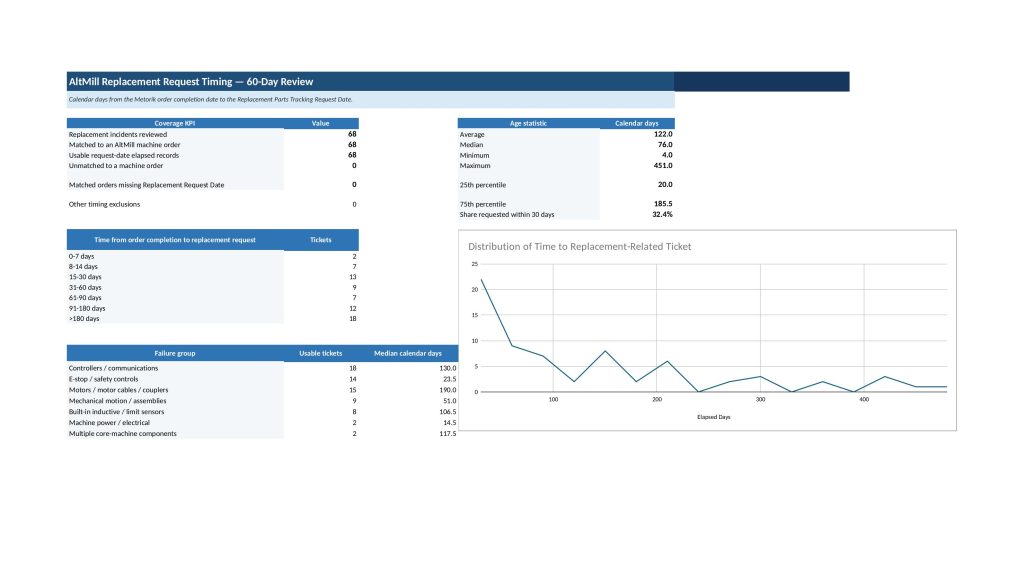
To give some context of what is going on in the back end, we reviewed tickets from the last 60 days for the AltMill.
Here’s a look at our stats for warranty issues and tickets.
- In the last 60 days, approximately 60.3% of issues happened within the first 120 days.
- Increasing the warranty from 120 days to one year (365 days) means capturing approximately 92.6% of the issues, rather than 60.3%
- Controller and motor/coupler issues (electrical) make up the majority of issues, making up 69%
Changes to expect
With all of the data analyzed, there are a few changes in the works to help us focus on new areas of improvement.
First is reviewing the designs of our key failure points, mainly with the electronics systems. We’ve observed that most of the issues come from controller/estop or motor/coupler related issues. With current development of the new SLB-EXT V2 and SLB-Lite, with more robust components and design, we expect to see a significant decrease in these issues.
We’re also reviewing our QA processes, assembly instructions, and design to improve the overall reliability of the couplers as well, which also contributes to a big part of our overall pool of issues.
We’ve also set up some processes to keep a continual eye on issues week to week to identify trends so that they can be addressed and directed to the right people within the company to resolve. This includes weekly reports and analysis of technical support tickets, review of issues on our forum and other channels, and software usage logs.
Our main goal is to continue to improve the overall performance and reliability of our products. While an update to our warranty policies is a reflection of that, I believe that continual improvement should remain the primary focus of our development and ensure that the overall experience, warranty or not, is a great as it can be.